October 16, 2026
Things to Do in Valencia: City Sights, Day Trips and Tours
Architecture, Culture, Guide, History
Top attractions:
Valencia rewards the visitor who looks past the beach and the paella pan. The capital of the Comunidad Valenciana packs a Gothic merchants’ hall on the UNESCO list, two medieval city gates, a former riverbed turned into a green corridor, a market hall and Santiago Calatrava’s futuristic complex into a city you can cross by bike in an afternoon. This guide works through the city sights district by district, then moves on to food, festivals, the coast and day trips, with links to our detailed guides for each place and to tours where a guide adds real value.
A note on names: Valencia is bilingual. Valencian (valencià) and Castilian Spanish are both official, so street signs, menus and monuments often carry two forms: Llotja and Lonja, Torres dels Serrans and Torres de Serranos, Plaça and Plaza. We use the English name first, with the Castilian name in brackets.
The old town: Ciutat Vella
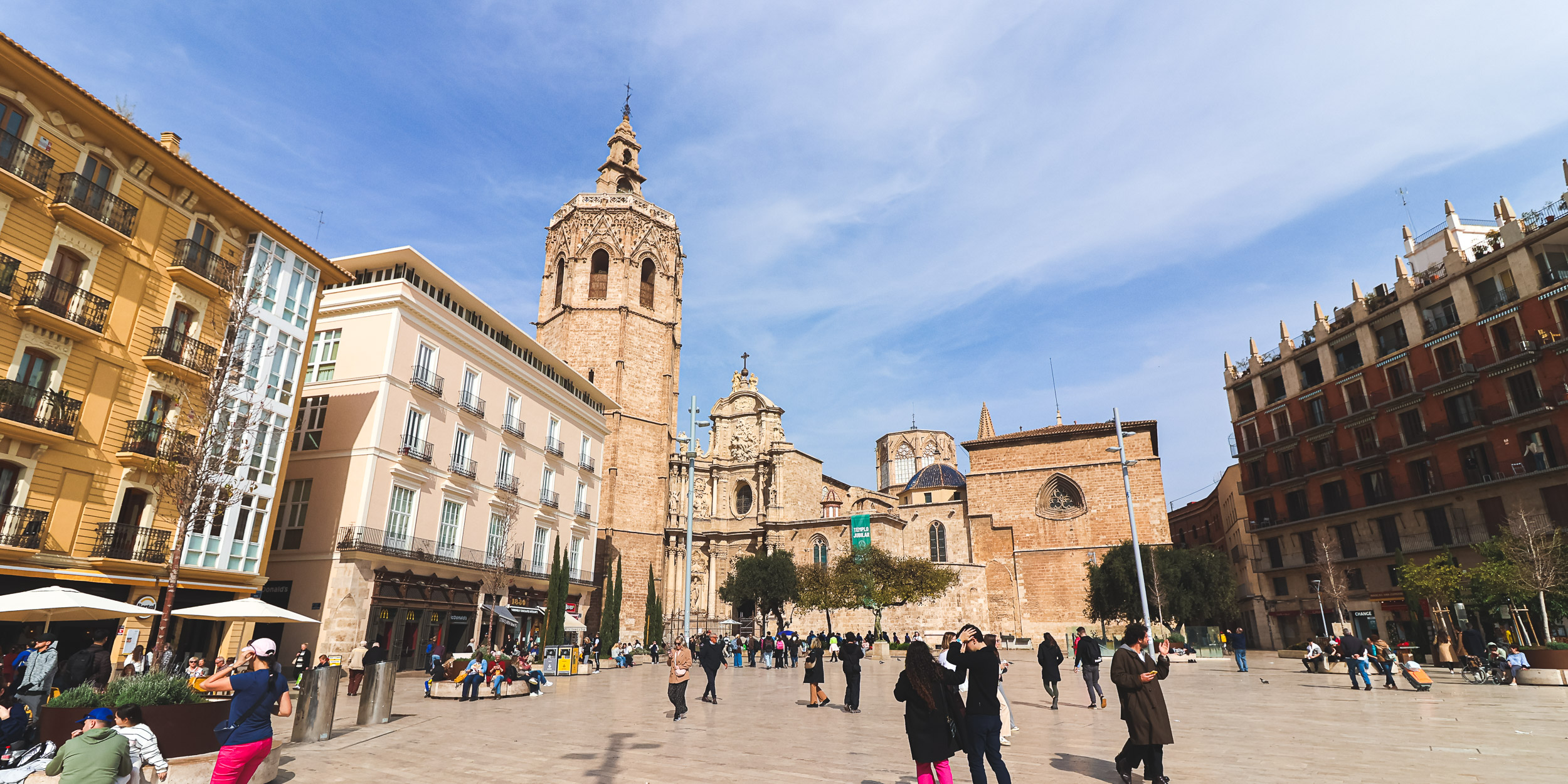
Valencia Cathedral (Catedral de Valencia). Photo by Alis Monte [CC BY-SA 4.0], via Connecting Valencia
Ciutat Vella, the walled city of the Middle Ages, holds most of Valencia’s historic monuments within walking distance of each other. The walls themselves came down in 1865; two of their gates survived, and they make natural start and end points for a walk through the old town.
Silk Exchange
The Silk Exchange (Lonja de la Seda), Llotja de la Seda in Valencian, is the city’s finest civil building and a UNESCO World Heritage Site since 1996, which describes it as a masterpiece of late Gothic architecture. The City Council laid the first stone in 1482, with Pere Compte and Joan Ivarra as architects; after Compte’s death in 1506, Johan Corbera took over, and the Consulate of the Sea wing was completed in 1548. Silk gave the building its name, but it was always a centre of commerce in general, and the Taula de Canvis, the city’s first municipal bank, did business in the trading hall.
That hall, the Hall of Columns, is the reason to come. Three aisles of Flamboyant Gothic vaults rest on slender helical columns almost 16 m (52 ft) high, often read as an image of paradise, with the columns as trees and the vaults as the heavens. A Latin inscription in Gothic letters runs around the walls, urging merchants not to practise usury. The tower once served as a prison for bankrupt merchants, and the Consulate of the Sea, the maritime trade court, has an upper gallery with 40 Renaissance medallions of Roman emperors and notable figures. The Orange Tree Courtyard (Patio de los Naranjos), begun in 1518, completes the complex. Outside, look for the crenellated roofline, the grotesque gargoyles and the main doorway with the Virgin and the royal arms of Aragon; the Consulate’s medallions are best seen from the pavement by the church of Santos Juanes.
The Silk Exchange opens Monday to Saturday 10:00–19:00 and Sundays and public holidays 10:00–14:00. General entry is €2 and free on Sundays and public holidays. Read our Silk Exchange guide for the full visit, and our guide to UNESCO heritage in Valencia for the wider context.
Central Market
Directly opposite the Silk Exchange, the Central Market (Mercado Central), Mercat Central in Valencian, is a modernist market hall opened in 1928, with around 259 stalls under its iron and glass. Seeing the Lonja’s merchants’ hall and the market across one square says much about a city that has lived from trade for centuries. Come in the morning, when locals do their shopping, and pair it with a cooking class that starts among the stalls.
Cathedral
Valencia Cathedral (Catedral de Valencia) anchors the old town on Plaza de la Virgen. Our Valencia Cathedral guide covers its history, architecture and how to plan the visit.
Plaza de la Virgen
Plaza de la Virgen, Plaça de la Mare de Déu in Valencian, is the old town’s main gathering place, framed by the Cathedral and the Basilica of the Virgin of the Forsaken (Basílica de la Virgen de los Desamparados). It is also the setting of the Water Tribunal (Tribunal de las Aguas), the historic irrigation court of the Valencian huerta, recognised by UNESCO as Intangible Cultural Heritage.
Serranos Towers
The Serranos Towers (Torres de Serranos), Torres dels Serrans in Valencian, take their name from the travellers and merchants of the Serranía who entered the city here. Master stonemason Pere Balaguer built them between 1392 and 1398 as the main gate on the road from Aragón and Catalonia, and kings and ambassadors made their entry through it. The gate was conceived as much as a triumphal arch as a defence, modelled on the Royal Gate of the Poblet monastery but larger: two large pentagonal towers flank a round arch, while the city side stands open, with arched galleries at several heights where leading families watched festivities and royal entries.
From 1586 to 1887 the towers served as a prison for nobles and knights, and that use is largely why they survived the demolition of the walls in 1865. Restoration ran from 1893 to about 1914. During the Spanish Civil War they sheltered masterpieces from the Prado Museum. Every year on the last Sunday of February the Fallera Mayor opens the Fallas from the towers in the Crida, the call to the festival.
Climb to the terraces for views over the rooftops and the old Turia riverbed; visits depend on daylight and can be limited by rain, fog or strong wind. Opening hours are Monday to Saturday 10:00–19:00 and Sundays and public holidays 10:00–14:00, with last entry 30 minutes before closing. Entry is €2 (€1 reduced) and free on Sundays and public holidays. See our Serranos Towers guide for the full visit.
Quart Towers
The Quart Towers (Torres de Quart) are the other surviving gate of the medieval wall, built in the 15th century. Serranos and Quart share the same ticketing pattern (€2, free on Sundays and public holidays), so it is easy to see both in a day: Our Quart Towers guide has the history and visiting details.
Turia Gardens
The Turia Gardens (Jardín del Turia), Jardí del Túria in Valencian, are the city’s green spine. After the flood of 1957, Valencia diverted the Turia south of the city under the Plan Sur, and the dry riverbed became a park that curves around the old town. It runs from Bioparc and Parque de Cabecera in the west to the City of Arts and Sciences in the east, passing Gulliver Park on the way, and is best covered by bike, linking most of the sights in this guide. The Palau de la Música, the city’s concert hall, stands in the gardens.
City of Arts and Sciences
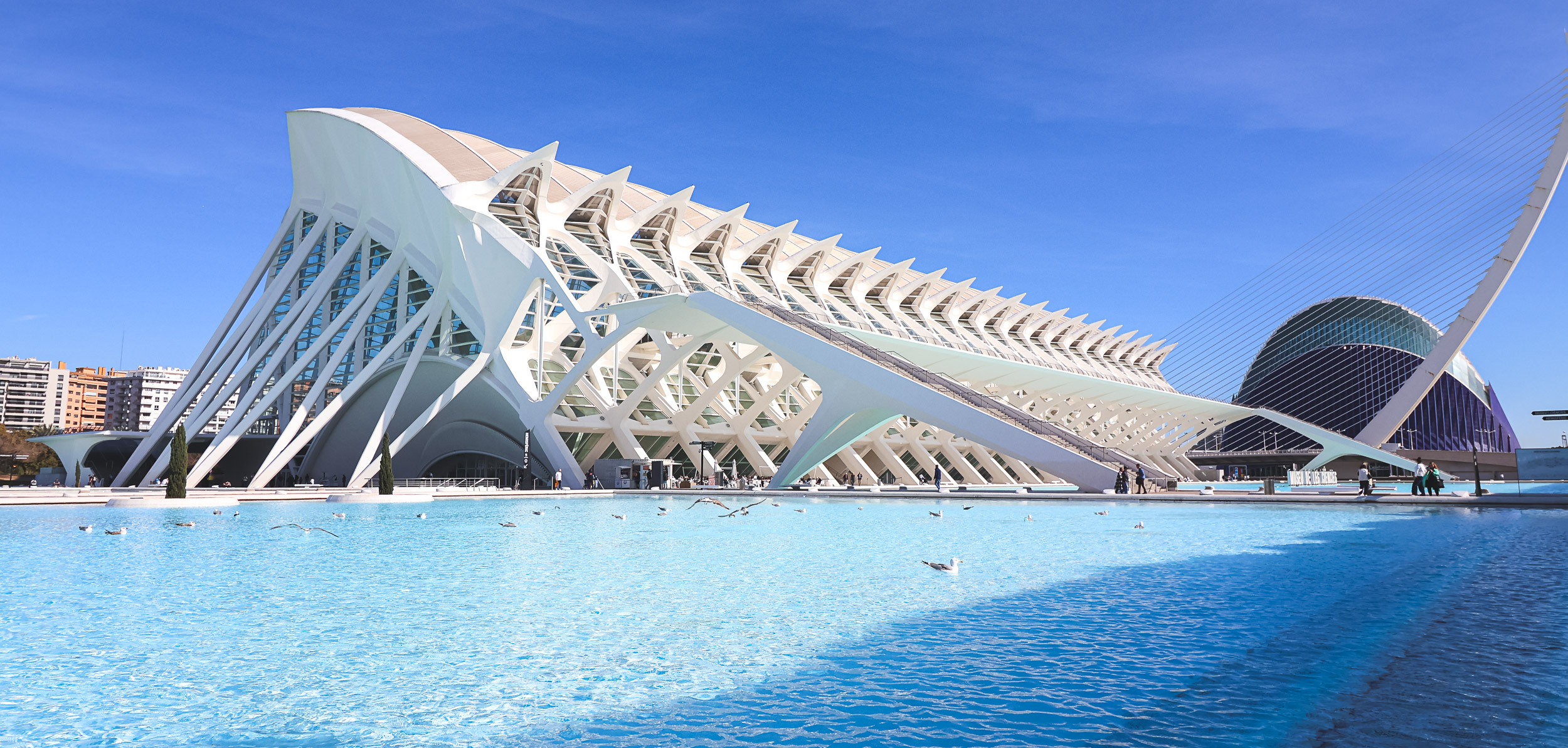
Science Museum (Museo de las Ciencias), City of Arts and Sciences. Photo by Alis Monte [CC BY-SA 4.0], via Connecting Valencia
At the eastern end of the Turia Gardens, the City of Arts and Sciences (Ciudad de las Artes y las Ciencias), Ciutat de les Arts i les Ciències in Valencian, is Santiago Calatrava’s complex of science, nature and performing-arts buildings, and a full day out in itself. Start with our City of Arts and Sciences guide, then go building by building:
- Oceanogràfic: the marine park.
- Hemisfèric: see our guide.
- Science Museum: see our guide.
- Umbracle: see our guide.
- Queen Sofia Palace of Arts: see our guide.
Bioparc

Leopard in Bioparc Valencia. Photo by Alis Monte [CC BY-SA 4.0], via Connecting Valencia
At the opposite, western end of the Turia Gardens, Bioparc (Bioparc Valencia) opened in 2008 as a zoo built around immersive African habitats: savannah, equatorial forest and wetlands. Our Bioparc Valencia guide covers the visit. Combine it with a ride along the gardens to the Oceanogràfic for a family day that spans the city from west to east.
Food: paella and horchata
Paella valenciana
In Valencia, paella is the name of the pan before it is the name of the dish, and the dish is closer to a technique: grains whole, loose, dry and full of flavour, cooked in a thin layer with a toasted base, the socarrat. Tradition holds that it was born among the rice fields of the Albufera, south of the city. Wikipaella, which studied more than 170 restaurant recipes, lists ten basic ingredients for paella valenciana: rice, water, olive oil, salt, saffron, tomato, flat green beans (ferraura), garrofó (a large white lima bean), chicken and rabbit. Common extras include paprika, rosemary, snails and, in winter, artichoke, and Wikipaella records six regional variants, from Castellón to La Marina. Seafood rice and arroz a banda are fine dishes, but they are not paella valenciana.
The rice matters too. The Arroz de Valencia designation of origin protects three varieties suited to the Albufera: Senia, Bomba and Albufera. Paella is a lunch dish, and locals often eat it at midday, especially on Sundays; book ahead at weekends. Long-established addresses include Casa Carmela in Malvarrosa, which cooks over orange wood and asks you to pre-order Valencian paella, and La Pepica on the Paseo de Neptuno beachfront. Our guide to paella in Valencia goes deeper into origins, ingredients and where to eat.
Horchata
Horchata (orxata in Valencian) is made from tiger nuts (chufa), which hold a designation of origin, and is served with fartons.
Festivals: Fallas and Semana Santa Marinera
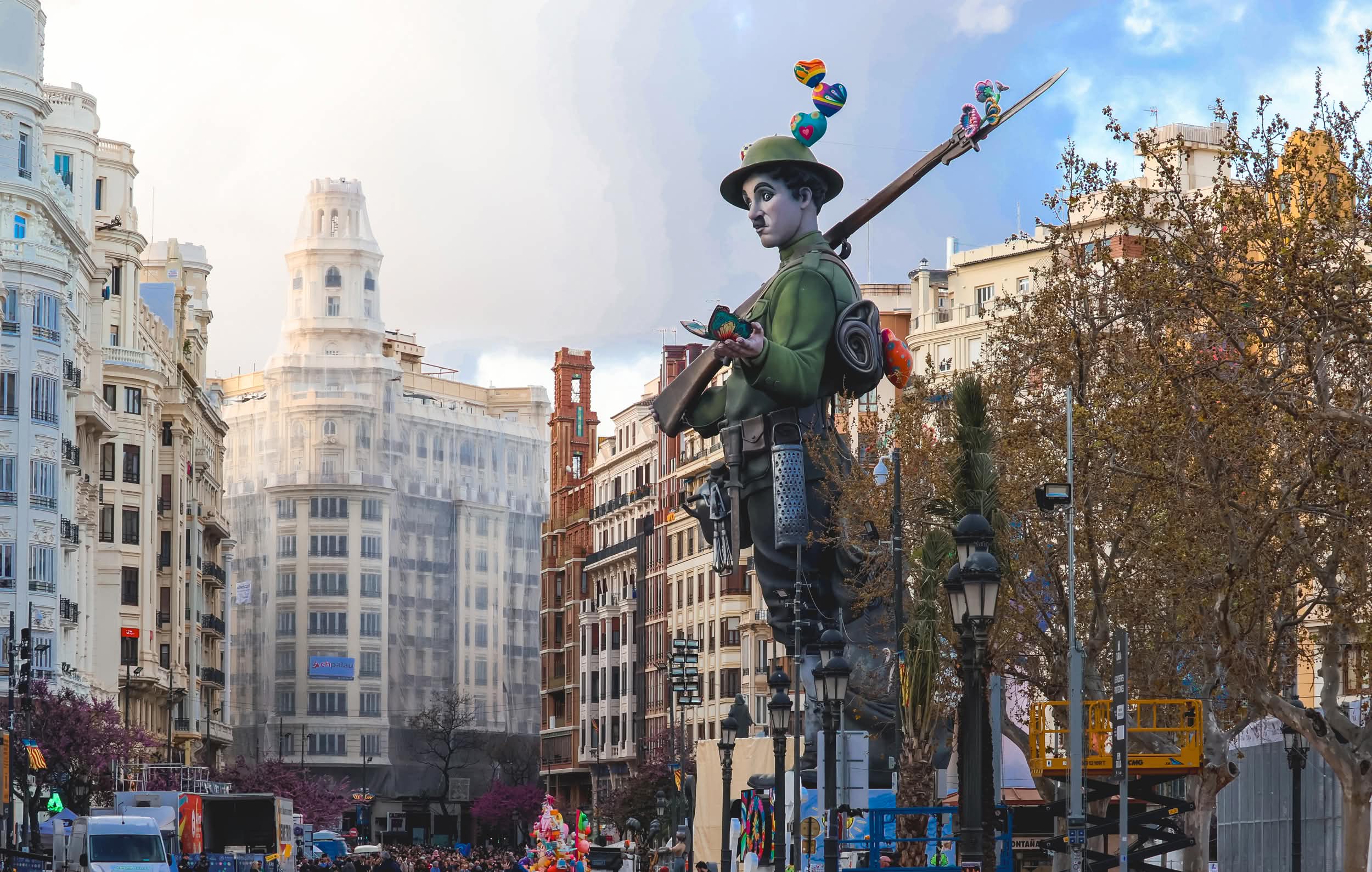
Municipal falla, Plaza del Ayuntamiento, Fallas 2026. Photo by Alis Monte [CC BY-SA 4.0], via Connecting Valencia
The Fallas fill the streets from 15 to 19 March, when neighbourhood associations raise monuments of wood and papier-mâché, and burn them on the night of 19 March, the feast of Saint Joseph. The festival is announced weeks earlier with the Crida at the Serranos Towers on the last Sunday of February. The Fallas Museum has kept the pardoned ninots, figures saved from the flames, since 1934. Our Fallas guide covers the programme. In the maritime districts, Holy Week takes its own form in the Semana Santa Marinera.
Beaches
Valencia’s city beaches, Malvarrosa and Las Arenas, run along the seafront with the old fishermen’s quarter of El Cabanyal behind them. Tram line 4 serves Malvarrosa.
Day trips from Valencia
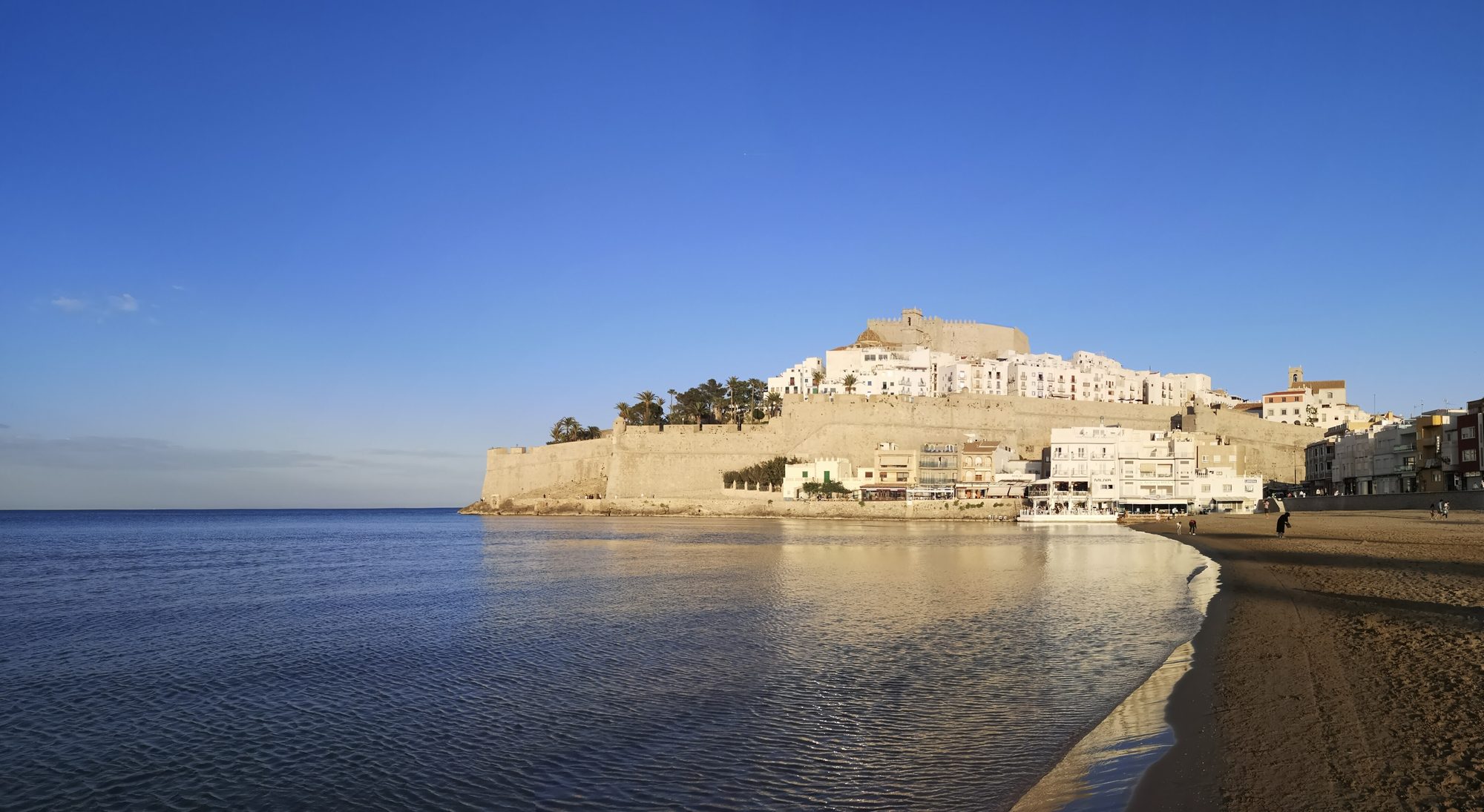
Peñíscola Castle (Castillo de Peñíscola), a day trip from Valencia. Photo by Alis Monte [CC BY-SA 4.0], via Connecting Valencia
Albufera and El Palmar
The Albufera, the lagoon and rice fields south of the city, is where paella’s rice grows, and El Palmar, its village, is the classic place to eat it. Boat rides on the lagoon, often timed for sunset and combined with a paella lunch, are the usual way to visit.
Further afield
Beyond the city, the Comunidad Valenciana opens up in every direction. Our day trips from Valencia guide compares the options; three of the best are Xàtiva, Peñíscola and Guadalest.
Getting around and saving money
The Valencia Tourist Card gives free entry to the Silk Exchange, the Serranos Towers and the Quart Towers, along with transport and other museums, which quickly pays off if you plan to see the old town in depth. A hop-on hop-off bus gives a city-wide overview on a first day, and a self-guided audio tour is the budget way to walk the old town at your own pace.
Options: Valencia tours, tickets and the Valencia Tourist Card on GetYourGuide.
Frequently Asked Questions
Which sights in Valencia are free?
The Silk Exchange, the Serranos Towers and the Quart Towers are free on Sundays and public holidays; on other days entry is €2. The Valencia Tourist Card also gives free entry to all three.
When are the Fallas?
The Fallas run from 15 to 19 March, and the monuments burn on the night of 19 March, the feast of Saint Joseph. The festival is opened on the last Sunday of February with the Crida at the Serranos Towers.
How long does a visit to the Serranos Towers take?
Allow 1 to 1.5 hours, including the climb to the terraces. Visits depend on daylight and can be limited by rain, fog or strong wind.
When do locals eat paella?
Paella is a lunch dish, often eaten at midday on Sundays. Book ahead at weekends.