October 21, 2026
Valencia Old Town Walking Route: Half a Day in Ciutat Vella
Architecture, Culture, History
Top attractions:
Valencia’s old town, Ciutat Vella, holds two thousand years of the city in a few streets: the Roman forum, the medieval gates, a Gothic merchants’ hall, a Baroque basilica and a Modernist market. This route links the essentials in a logical line, from the northern gate to the western one, so you never double back. With the visits below, allow half a day, and start in the morning so the Central Market is still trading.
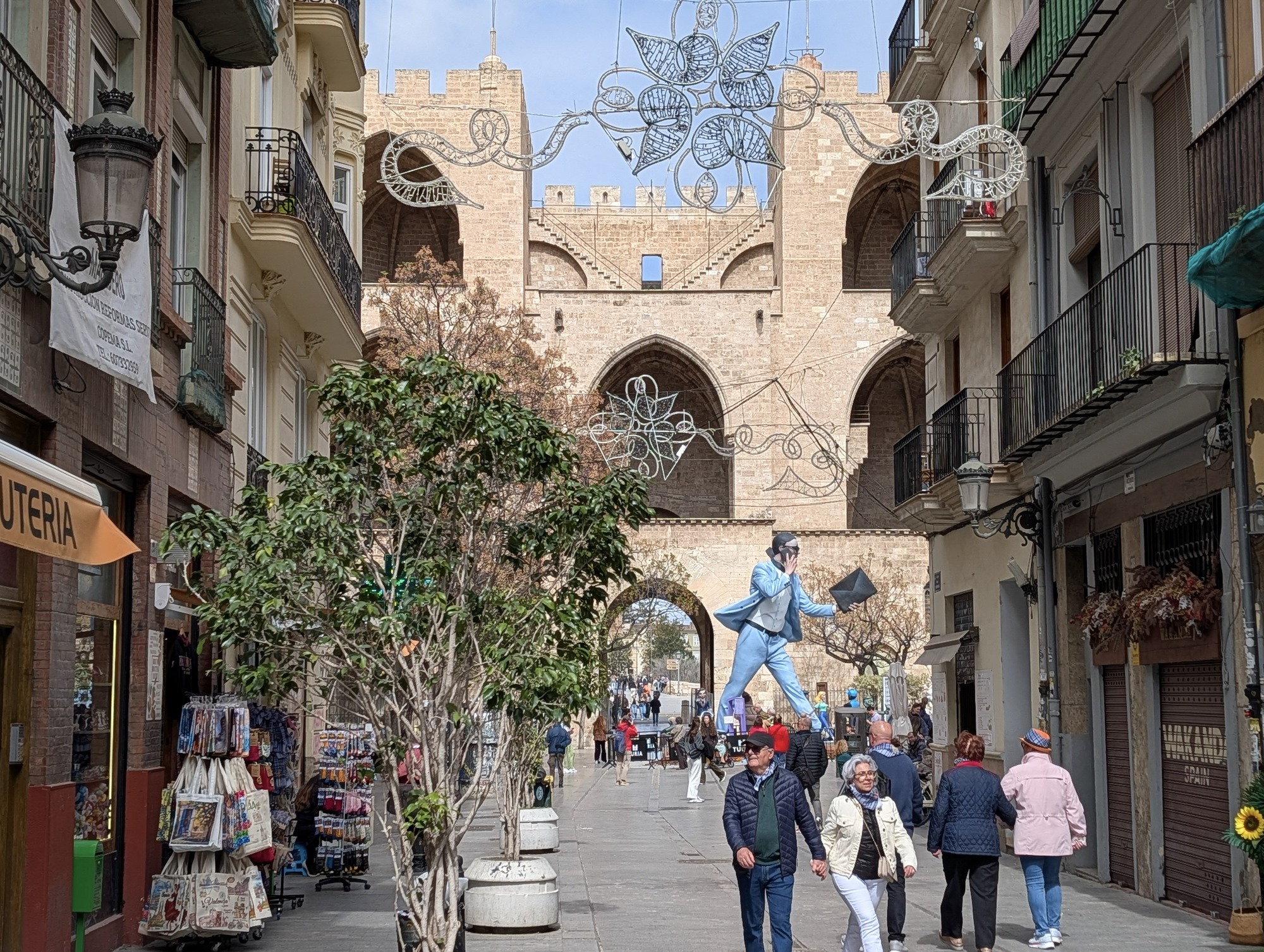
Calle Serranos and the inner side of the Serranos Towers (Torres de Serranos), where the route begins. Photo by Alis Monte [CC BY-SA 4.0], via Connecting Valencia
1. Serranos Towers
Begin at the Serranos Towers (Torres de Serranos), the gate by which travellers from the north once entered the walled city. The side facing the city is an open, galleried façade, built for ceremonies and the official entries of the kings of the Crown of Aragon. Climb to the top for the view over the Turia Gardens (Jardín del Turia) on one side and the rooftops of the old town on the other. The towers are open Mon–Sat 10:00–19:00 and on Sundays and public holidays 10:00–14:00; entry is €2 and free on Sundays and public holidays. Last entry is 30 minutes before closing, and the towers close on 1 and 6 January, 1 May and 25 December.
From the gate, walk south along Calle Serranos and its continuation towards the Cathedral.
2. Plaza de la Virgen
You reach Plaza de la Virgen, roughly the site of the Roman forum. Step into the Basilica of Our Lady of the Forsaken (Real Basílica de Nuestra Señora de los Desamparados), described by the city as Valencia’s first newly built Baroque church and home of the patron Valencians call la Geperudeta. It is open daily 07:30–14:00 and 16:30–21:00, closed at midday, and no ticket is needed for the church. In the middle of the square, the Turia Fountain (Fuente del Turia) shows the river surrounded by the eight irrigation channels of the huerta. If it is a Thursday, be at the cathedral’s Apostles’ Door (Puerta de los Apóstoles) before 12:00 for the Water Tribunal (Tribunal de las Aguas).
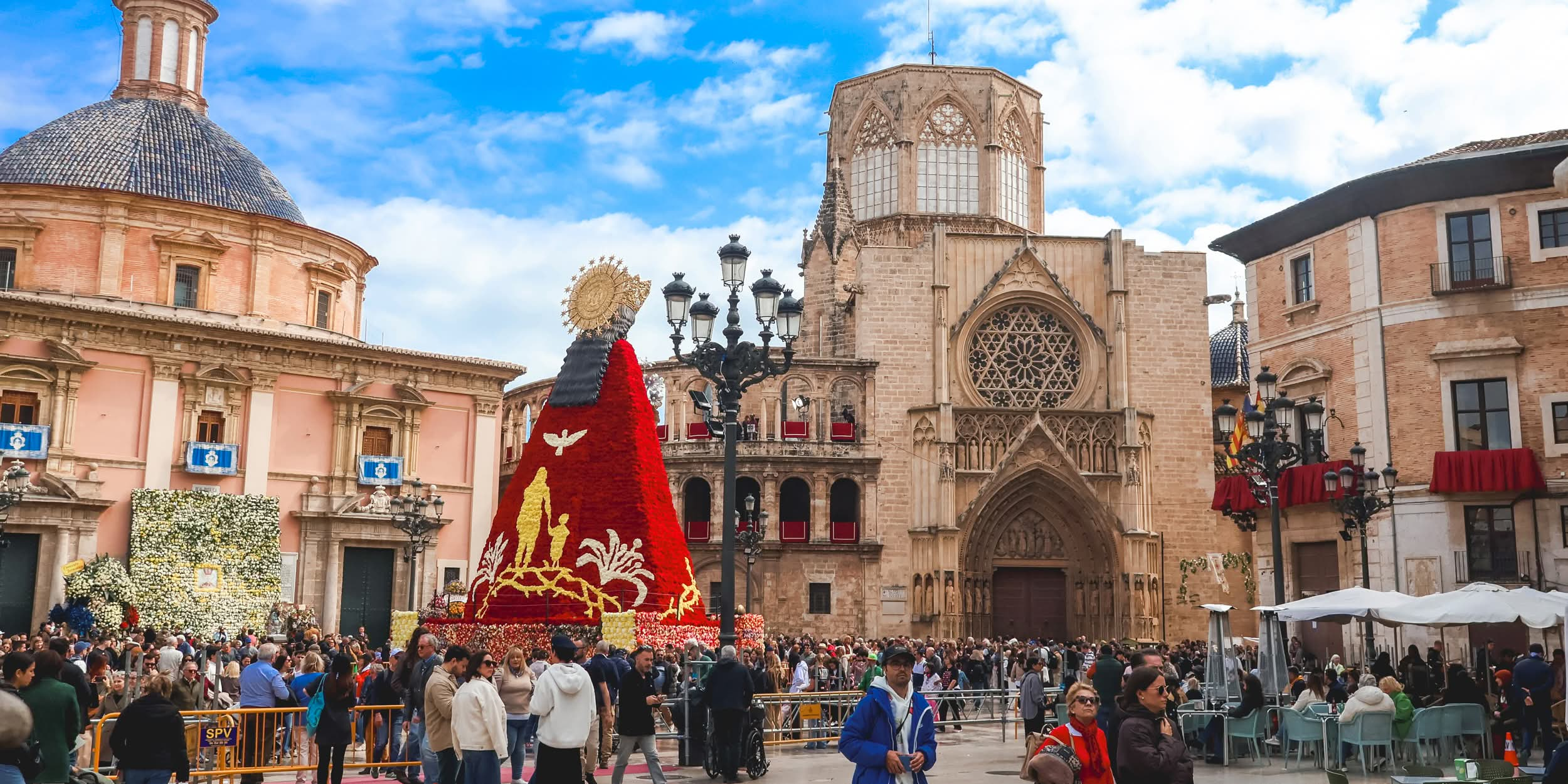
Plaza de la Virgen, the old heart of the city. Photo by Alis Monte [CC BY-SA 4.0], via Connecting Valencia
3. The Cathedral and the Micalet
Walk round the Cathedral (Catedral de Valencia) to Plaza de la Reina. Consecrated in 1238 in the former main mosque and rebuilt from 1262, its Chapel of the Holy Chalice (Capilla del Santo Cáliz) keeps an agate cup, which the Cathedral dates to the 1st century BC, venerated by tradition as the Holy Grail. Cultural visits run Mon–Fri 10:30–18:30, Sat 10:30–17:30 and Sun 14:00–17:30 (July–September Mon–Sat 10:30–18:30, Sun 14:00–18:30) and pause during services. The bell tower, the Micalet (Miguelete), can be climbed daily 10:00–18:45, last entry 30 minutes before closing, for the best panorama of the old town. Tickets are in our cathedral guide.
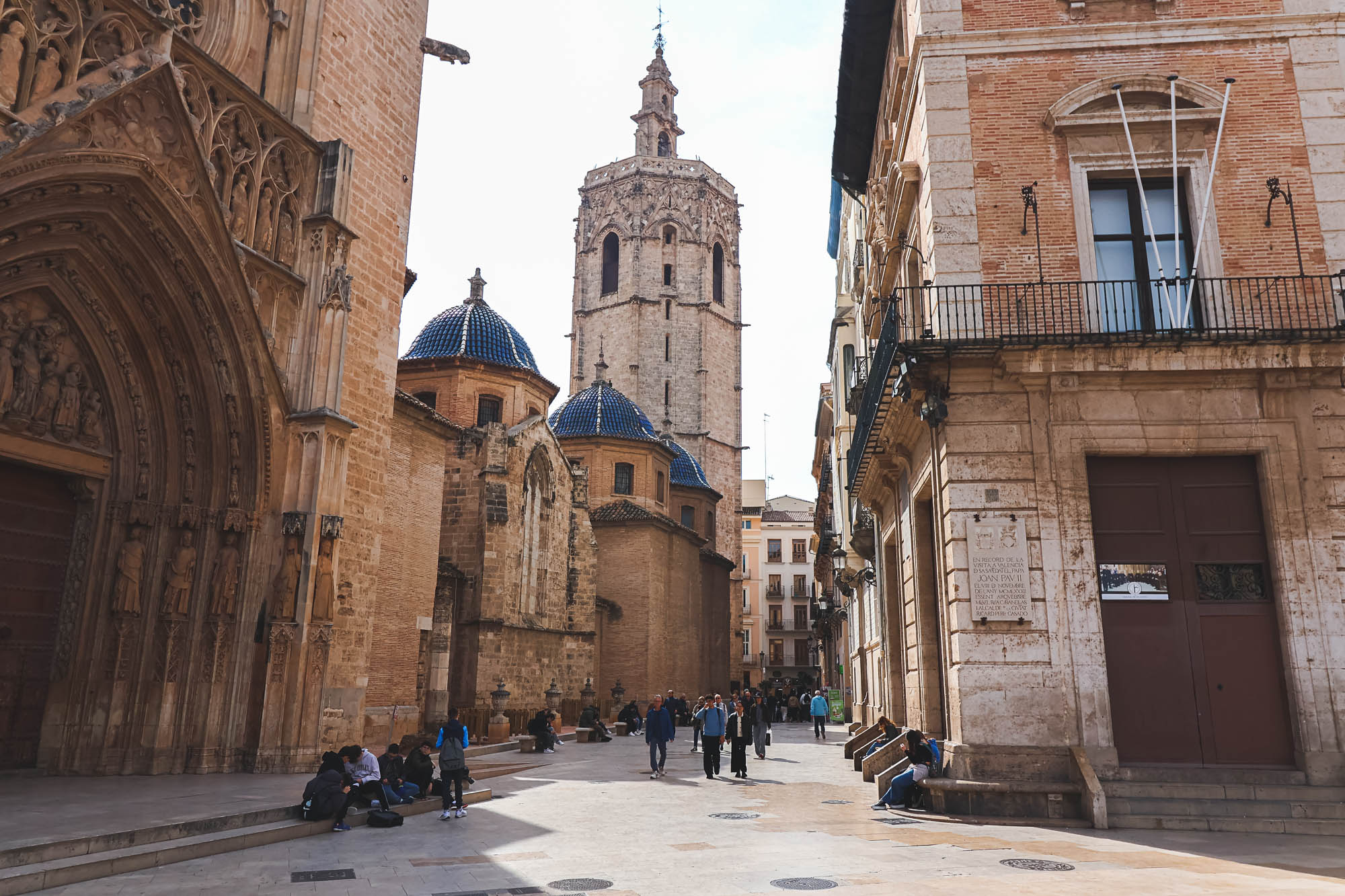
The Micalet (Miguelete), the bell tower of Valencia Cathedral (Catedral de Valencia). Photo by Alis Monte [CC BY-SA 4.0], via Connecting Valencia
4. The Silk Exchange and the Central Market
From Plaza de la Reina, head west through the narrow streets to Plaza del Mercado, where the two great buildings of Valencian trade face each other. The Silk Exchange (Lonja de la Seda), the Gothic merchants’ hall on the UNESCO World Heritage list, has a hall of twisted columns, a small orange-tree courtyard and grotesque gargoyles outside; it keeps the same hours and €2 ticket as the city’s gates, free on Sundays and public holidays. Across the street, the Central Market (Mercado Central), opened in 1928, is one of the great works of Valencian Modernisme, with iron, glass and ceramic domes. It trades Mon–Sat 07:30–15:00 and closes on Sundays and public holidays, so this is the stop to time for late morning, and a good place to buy lunch. More on the UNESCO side in our guide to Valencia’s UNESCO heritage.
5. Quart Towers
Continue west along Calle de Quart to the Quart Towers (Torres de Quart), the 15th-century gate on the road to Castile, which still shows the marks of the 1808 French bombardment. They share the Serranos hours and prices, and the climb is steep but rewarding. You are now at the western edge of the old town, near the Botanical Garden (Jardín Botánico) and the Turia Gardens.
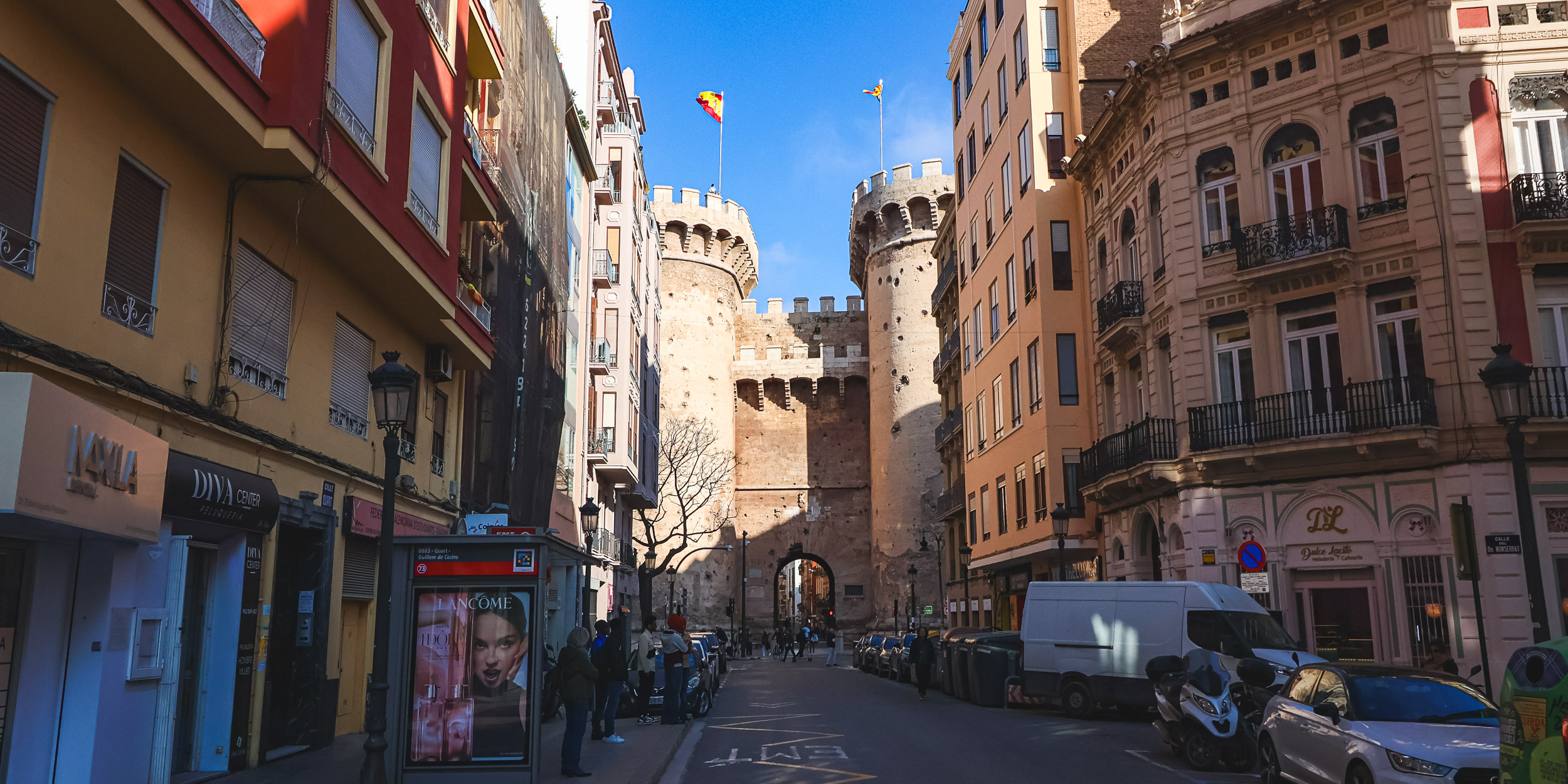
The Quart Towers (Torres de Quart), the end of the route. Photo by Alis Monte [CC BY-SA 4.0], via Connecting Valencia
Extending the Walk
From the Quart Towers, turn back into El Carmen, the old town’s northern quarter of street art, small squares and bars, and wander towards Serranos to close the loop. If you have more time, drop down into the Turia Gardens and follow them east towards the City of Arts and Sciences (Ciudad de las Artes y las Ciencias).
Practical Tips
- Sundays: the towers and the Silk Exchange are free, but the Central Market is closed and Cathedral cultural visits start only at 14:00, so choose a weekday or Saturday if the market matters to you.
- Midday: the Basilica closes 14:00–16:30 and the market shuts at 15:00; the towers, the Silk Exchange and the Micalet stay open.
- Churches: the Basilica and the Cathedral are working churches; dress modestly, keep your voice down and avoid sightseeing inside during Mass.
- Shoes: old town streets are paved in stone and the tower stairs are steep and uneven.
- Heat: in summer, do the climbs early and save the shaded streets for midday.
If you prefer a guide, local walking tours cover the same ground with stories you won’t find on signs; see Valencia tours on GetYourGuide. For background, read our history of Valencia, and for the rest of the city, things to do in Valencia.
Frequently Asked Questions
How long does the Valencia old town walk take?
With the visits, allow half a day; start in the morning so the Central Market is still trading.
Where does the route start and end?
It starts at the Serranos Towers and ends at the Quart Towers, the two surviving gates of the medieval wall.
Is it better to walk on a Sunday?
The towers and the Silk Exchange are free on Sundays and public holidays, but the Central Market is closed, so go Monday to Saturday if the market matters.
What are the Central Market's opening hours?
Monday to Saturday 07:30–15:00; closed Sundays and public holidays.