October 20, 2026
Plaza de la Virgen Valencia: Basilica, Fountain, Water Court
Architecture, Culture, History
Top attractions:
Plaza de la Virgen stands on the site of the forum of Roman Valentia, the city’s centre since its founding in 138 BC, and it is still Valencia’s living room. Around it stand the Cathedral (Catedral de Valencia), the Basilica of Our Lady of the Forsaken (Real Basílica de Nuestra Señora de los Desamparados) and the Turia Fountain (Fuente del Turia), a bronze to the river that made the city rich. Valencians come here to pray to their patron, to hand over flowers at Fallas and, every Thursday at noon, to watch farmers settle water disputes in a court that goes back to al-Andalus.
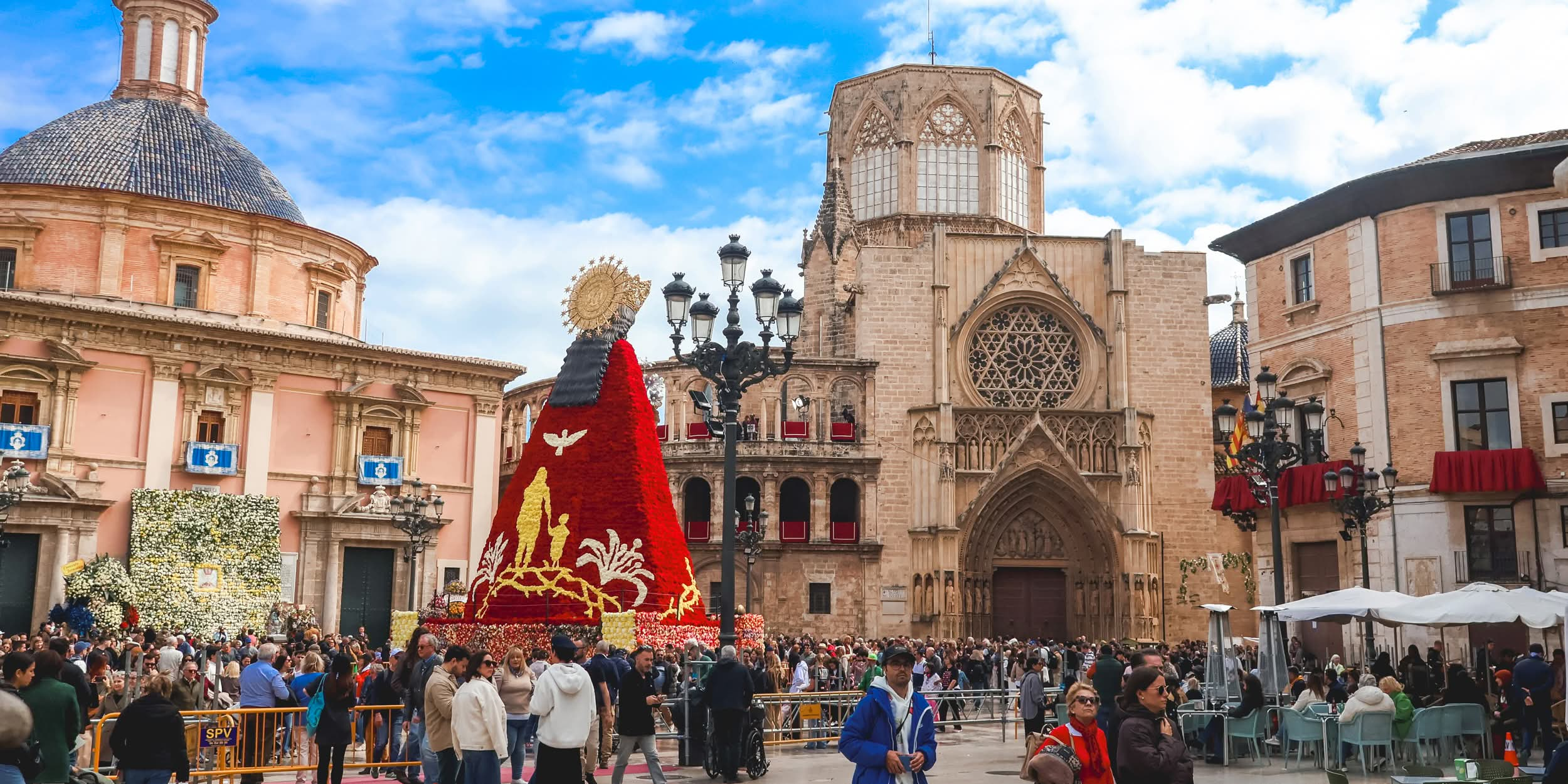
Plaza de la Virgen, with the Cathedral’s Apostles’ Door (Puerta de los Apóstoles) and the Basilica of Our Lady of the Forsaken (Real Basílica de Nuestra Señora de los Desamparados) on the right. Photo by Alis Monte [CC BY-SA 4.0], via Connecting Valencia
The Basilica of Our Lady of the Forsaken
The domed church joined to the Cathedral by an arch is the Basilica of Our Lady of the Forsaken, home of Valencia’s patron. Built between 1652 and 1667, it is described by the city as Valencia’s first newly built Baroque church. The architect, Diego Martínez Ponce de Urrana from Requena, set an oval dome over an irregular four-sided plan. The camarín, the chamber behind the altar where the image stands, followed in 1685–1694, and in 1701 Antonio Palomino painted the vault of the dome. It was declared a National Historic-Artistic Monument in 1981.
La Geperudeta and the forsaken
The image Valencians call “la Geperudeta”, the little hunchback, is a 15th-century Gothic wood carving. According to tradition, the tilted head has a reason: the image was carved to lie on the bodies of the dead during funeral processions, with a cushion under its head. The two small children at its feet, the innocents, were added in the 18th century. The devotion goes back to the confraternity founded in 1414 to support the newly founded Hospital of the Holy Innocents (Hospital de los Santos Inocentes), Father Joan Gilabert Jofré’s hospital for the mentally ill; its members also buried the abandoned, the executed and the shipwrecked, the “forsaken” of the name.
The Basilica is open daily 07:30–14:00 and 16:30–21:00, closed at midday; times can change for services, and the Mass times are on the Basilica’s website. No ticket is needed for the church; the Marian Museum (Museo Mariano, muMA), which is paid, is entered from the neighbouring Almoina Square (Plaza de la Almoina). It is a working church with near-constant worship, so visit quietly, dress modestly and avoid photography during Mass.

The square from its western side, with the Turia Fountain (Fuente del Turia). Photo by Alis Monte [CC BY-SA 4.0], via Connecting Valencia
The Turia Fountain
In the middle of the square, the Turia Fountain shows a bearded bronze giant reclining with a horn of plenty overflowing with fruit: the river Turia, modelled on ancient statues of the Nile and the Tiber. Around him eight young women, each with the combed hair of a Valencian farm girl and a jug of running water, stand for the eight irrigation channels fed by the river: Quart, Benàger i Faitanar, Tormos, Mislata, Mestalla, Favara, Rascanya and Rovella. The fountain is by the sculptor Manuel Silvestre Montesinos, known as Silvestre de Edeta, and was unveiled in 1976, a year after the square was remodelled and made pedestrian.
The Water Tribunal
Those eight channels have their own court. Every Thursday at 12:00, the syndics of the Water Tribunal (Tribunal de las Aguas), farmers elected by the users of each channel, take their seats outside the cathedral’s Apostles’ Door (Puerta de los Apóstoles), on the square, and hear complaints about the sharing of irrigation water in the huerta, the farmland around the city. The tribunal’s roots go back to al-Andalus, and in 2009 UNESCO inscribed it, with the Council of Wise Men of Murcia, as Intangible Cultural Heritage. Arrive a little before noon to find a good spot. More in our guide to Valencia’s UNESCO heritage.
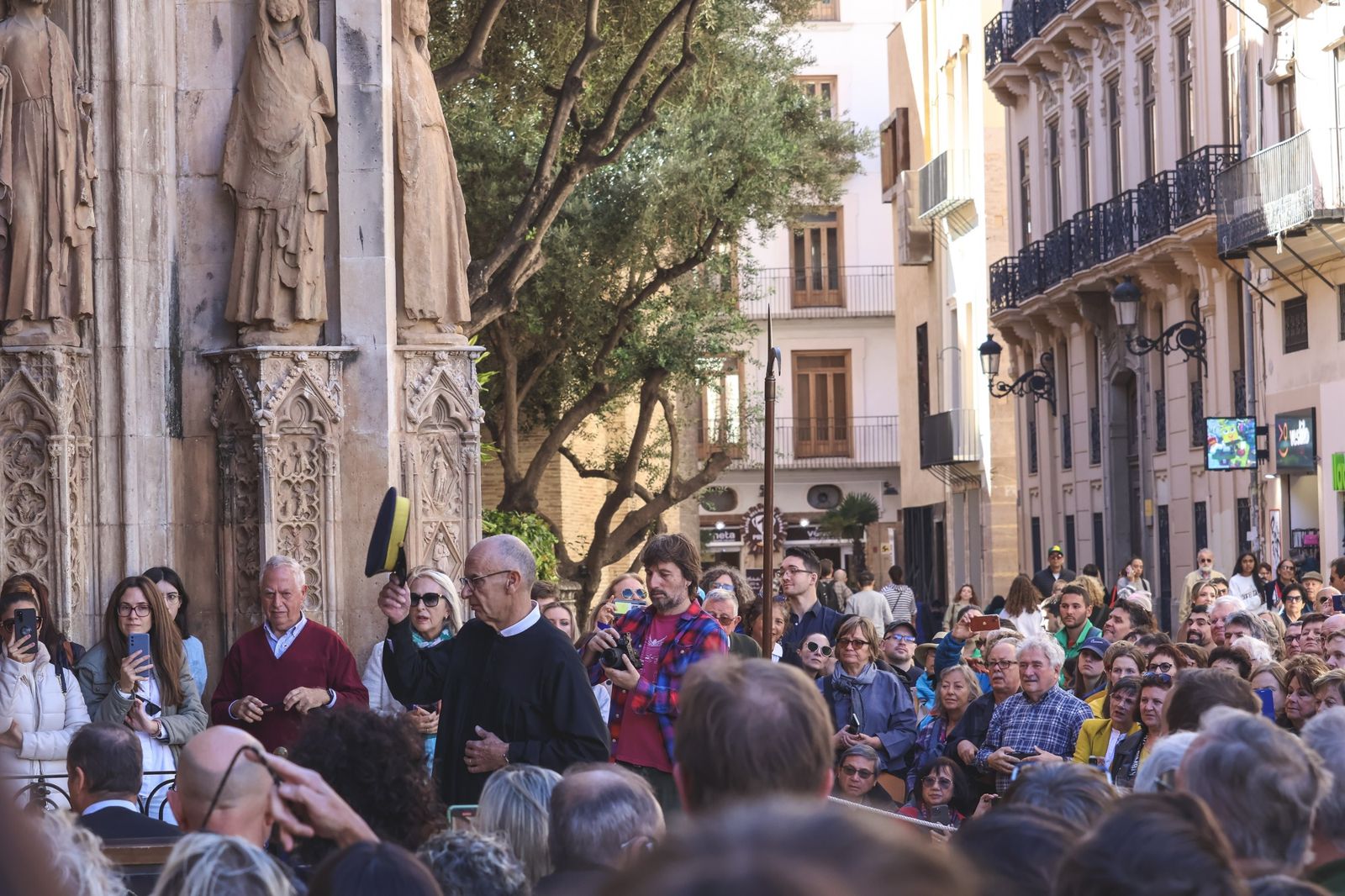
The Water Tribunal (Tribunal de las Aguas) at the cathedral’s Apostles’ Door (Puerta de los Apóstoles), with its robed members and bailiff. Photo by Alis Monte [CC BY-SA 4.0], via Connecting Valencia
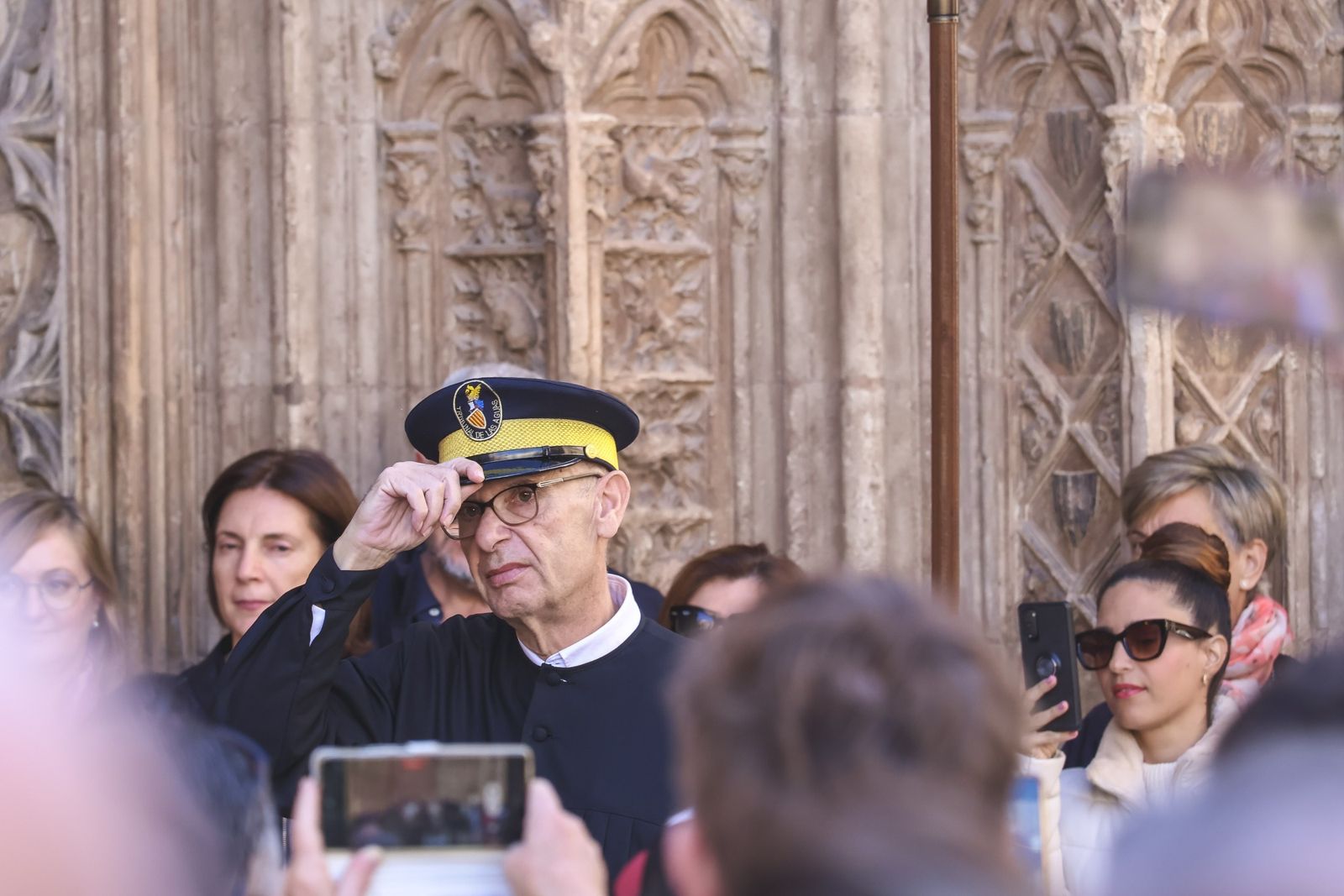
The bailiff of the Water Tribunal (Tribunal de las Aguas) in front of the Apostles’ Door (Puerta de los Apóstoles). Photo by Alis Monte [CC BY-SA 4.0], via Connecting Valencia
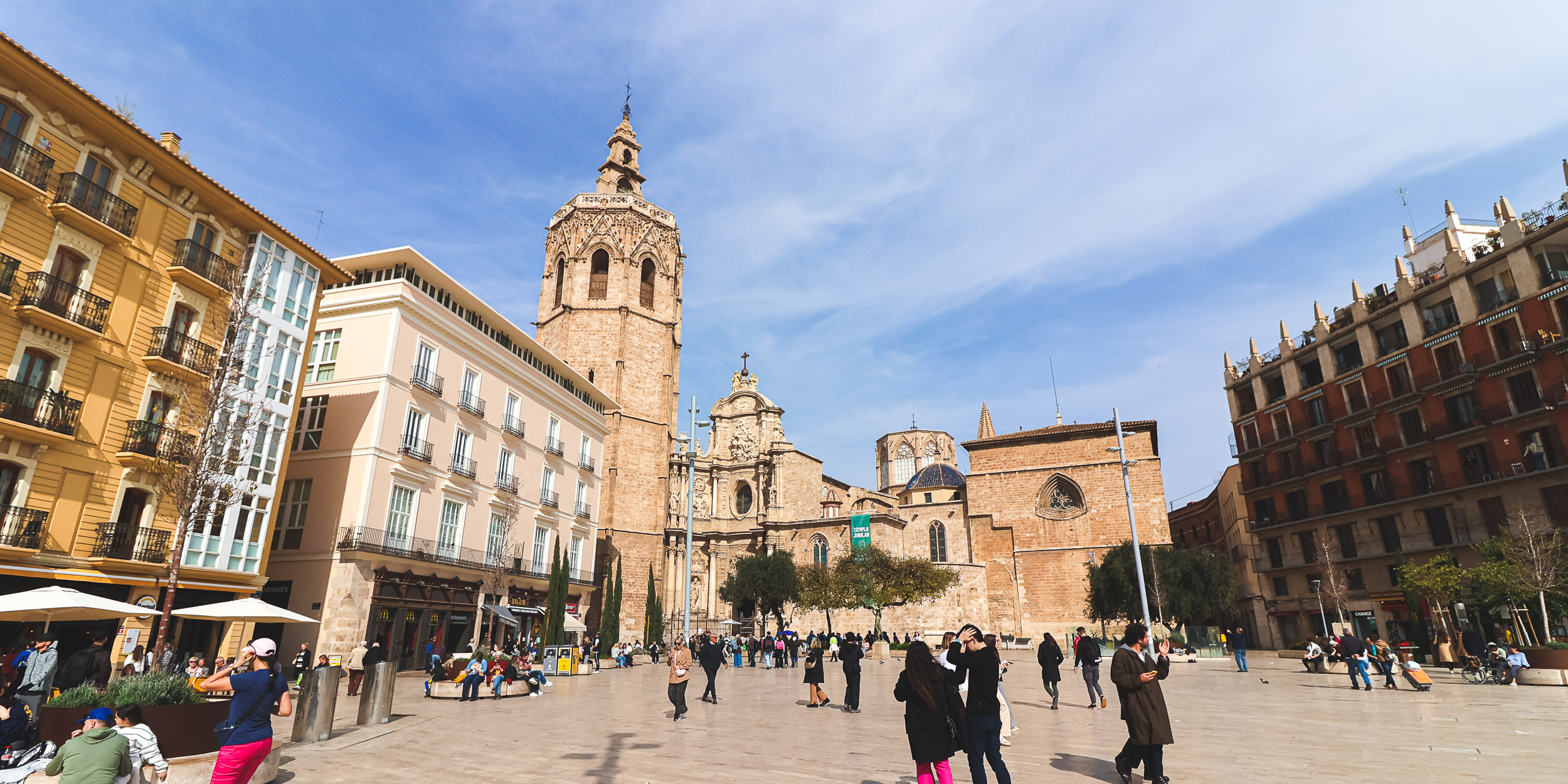
Valencia Cathedral (Catedral de Valencia), whose Apostles’ Door (Puerta de los Apóstoles) faces the square. Photo by Alis Monte [CC BY-SA 4.0], via Connecting Valencia
The Offering of Flowers at Fallas
The Offering of Flowers (Ofrenda de Flores) takes place on 17 and 18 March: from 15:30 until around midnight or later, tens of thousands of falleros and falleras in traditional dress walk through the city to this square to give flowers to the Virgin. Here a giant wooden frame in the shape of the Geperudeta waits; a team of dressers climbs it and places each bouquet to build her cloak, whose design is different every year. The most moving stretch is the final approach along Calle de la Paz and Calle de San Vicente into the square.
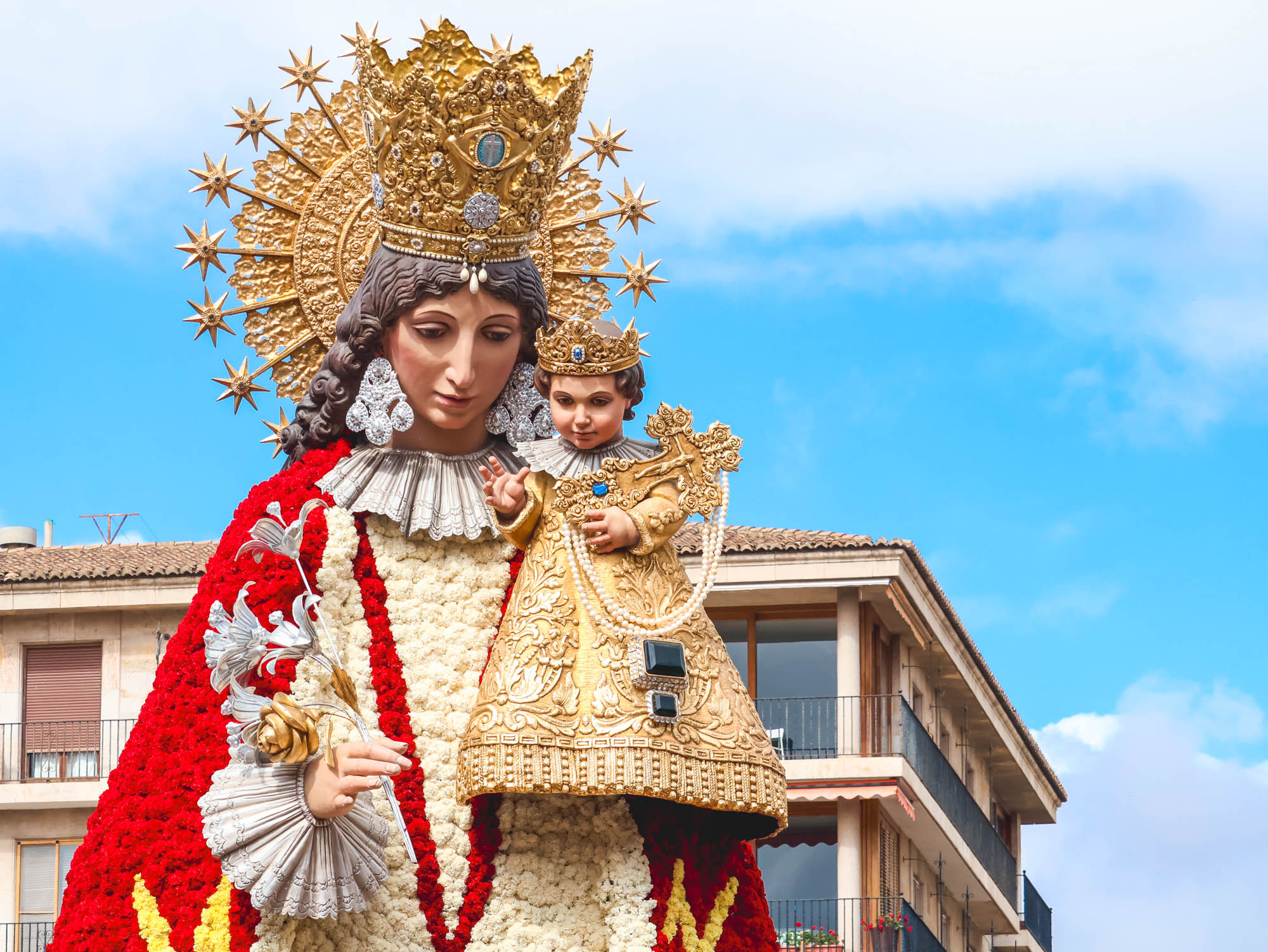
The flower cloak of the Virgin of the Forsaken (Virgen de los Desamparados) at the Offering of Flowers (Ofrenda de Flores), Fallas 2026. Photo by Alis Monte [CC BY-SA 4.0], via Connecting Valencia
The Feast of the Virgin in May
The Virgin’s own feast falls on the second Sunday of May. That day the image is carried across the square from the Basilica to the Cathedral, through one of the densest crowds of the year. It is a deeply religious occasion, so give the faithful room.
Around the Square
Plaza de la Virgen is the natural start of any walk through the old town. The Cathedral faces it, with its Micalet (Miguelete) bell tower rising at the far end on Plaza de la Reina; Almoina Square, where archaeologists uncovered the Roman city, is behind the Basilica, and the Serranos Towers (Torres de Serranos) are a short walk north. Our old town walking route starts here. To understand why the forum, mosque and cathedral all stood on this spot, read our history of Valencia, and for more ideas see things to do in Valencia.
Guided walks of the old town almost always start or pass here; browse Valencia tours on GetYourGuide.
Frequently Asked Questions
What is Plaza de la Virgen known for?
It stands on the site of the forum of Roman Valentia, with the Basilica of Our Lady of the Forsaken (Real Basílica de Nuestra Señora de los Desamparados), the Cathedral's Apostles' Door (Puerta de los Apóstoles) and the Turia Fountain (Fuente del Turia).
When does the Water Tribunal meet?
Every Thursday at 12:00 outside the Cathedral's Apostles' Door, on Plaza de la Virgen. UNESCO inscribed it as Intangible Cultural Heritage in 2009.
When is the Basilica of Our Lady of the Forsaken open?
Daily 07:30–14:00 and 16:30–21:00, closed at midday; times can change for services. No ticket is needed for the church; the Marian Museum (Museo Mariano, muMA) is paid.
Who is la Geperudeta?
The nickname of the 15th-century image of the Virgin of the Forsaken, Valencia's patron; according to tradition, its head is tilted because it was carved to lie on the bodies of the dead during funeral processions.
When is the Offering of Flowers?
On 17 and 18 March during Fallas, from 15:30 until around midnight or later, when falleros bring flowers to build the cloak of a giant Virgin in the square.