Top attractions:
Valencia has been settled, besieged, razed, rebuilt and renamed more often than most European capitals, and the layers are still visible on the street. The Roman main street survives as Calle del Salvador, the Arabic wall turns up inside houses in El Carmen, the Gothic gates stand where the medieval city ended, and a river that flooded the city in 1957 is now a garden more than 9 km / 5.6 mi long. This history runs from the painted stones of the Ice Age to the present city, with the regional events that shaped it: Hannibal at Saguntum, Sertorius at Dénia, El Cid and Jaume I. Where the sources disagree, or where a story is tradition rather than record, we say so.
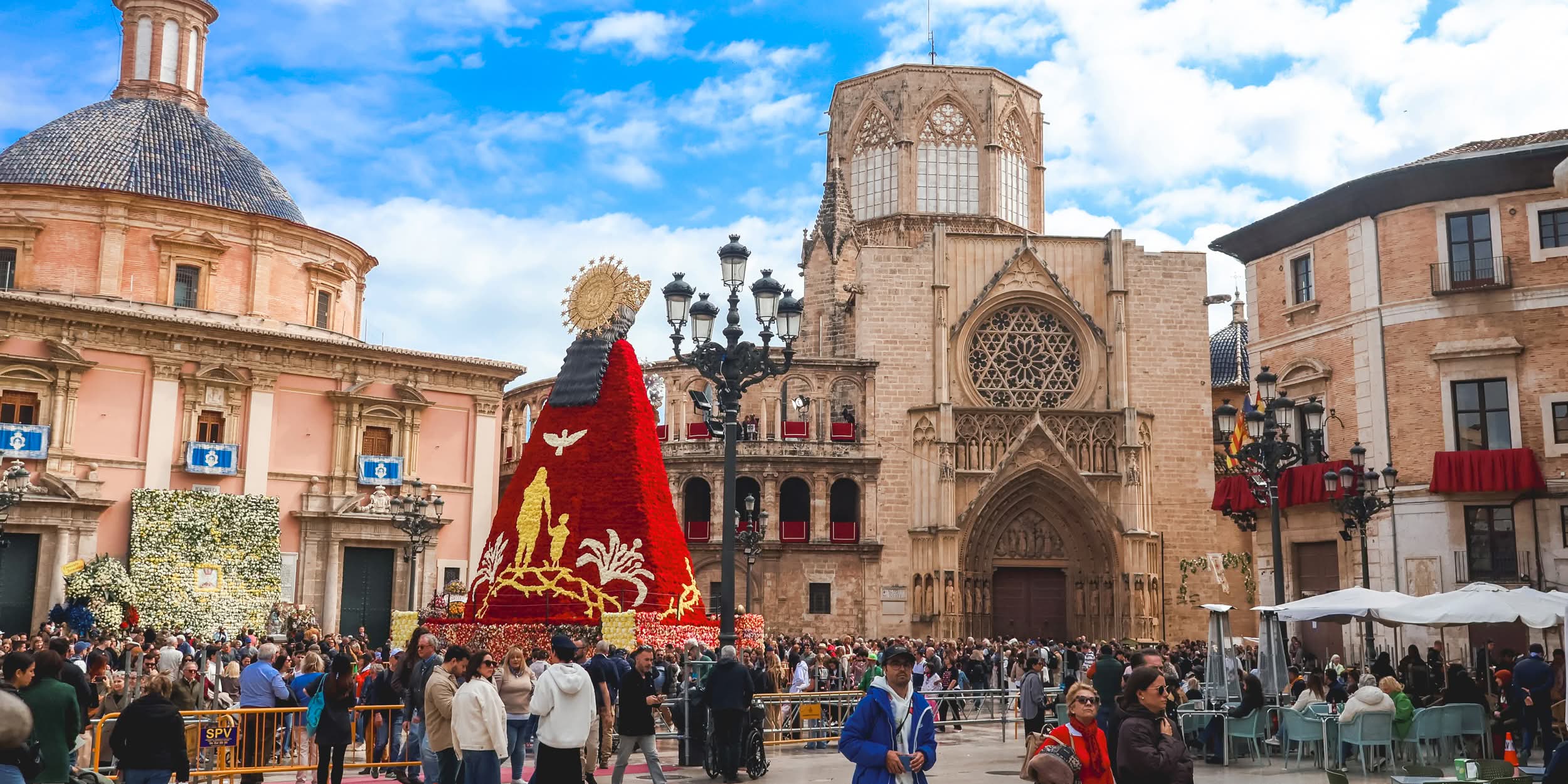
Plaza de la Virgen, roughly above the forum of Roman Valentia. Photo by Alis Monte [CC BY-SA 4.0], via Connecting Valencia
Prehistory: Parpalló, Rock Art and the Valencian Bronze Age
The oldest art in the region comes from the Cova del Parpalló near Gandia, an Upper Palaeolithic cave excavated in 1929–1931 by Lluís Pericot for Valencia’s Servicio de Investigación Prehistórica. It yielded 5,612 limestone plaquettes with 6,245 engraved or painted surfaces, made over many thousands of years. The earliest date from about 28,000 to 20,000 years ago and show deer, horses, ibex and cattle alongside geometric signs. Its Solutrean pieces matter well beyond Spain, because portable art from that period is rare elsewhere in Europe. The collection belongs to the Museum of Prehistory of Valencia (Museo de Prehistoria de Valencia) on Calle Corona, which displays a selection.
Later hunters and farmers painted the rock shelters of the interior. The Levantine rock art of the Mediterranean Basin, a UNESCO World Heritage Site since 1998, groups 758 sites across six regions, including the Comunidad Valenciana, and is the largest group of rock-art sites in Europe. Spain’s Ministry of Culture dates it to the Epipalaeolithic and Neolithic, roughly 10,000–3,500 BC, though the exact chronology is still argued over. The scenes are of hunting, dancing, archers and honey gathering.
In the 2nd millennium BC, small fortified hilltop villages spread across the region, and copper and then bronze tools appeared. Archaeologists call this the Valencian Bronze Age (Bronce Valenciano). Lloma de Betxí in Paterna, a village above the Turia about 4,000 years ago, is reconstructed in the Museum of Prehistory, and Mola d’Agres in the mountains of the south is known for its Late Bronze Age ivory working.
Where to See Prehistoric Valencia Today
- Museum of Prehistory of Valencia (Museo de Prehistoria de Valencia), Calle Corona 36: a selection of the Parpalló plaquettes, and the Bronze Age room with the reconstruction of Lloma de Betxí.
Iberians, Phoenicians and Greeks
In the last centuries BC the land between the Júcar and the Palancia rivers belonged to the Edetani, an Iberian people whose capital, Edeta, stood on the Tossal de Sant Miquel at Llíria, northwest of Valencia. It was lived in mainly from the 5th to the 2nd centuries BC, with houses on stepped terraces. Its painted pottery, showing warriors, rituals and dances, is one of the treasures of the Museum of Prehistory.
The coast was a trading frontier. From the late 8th and 7th centuries BC Phoenician ships called at the Valencian shore, followed by Greek, Punic and Etruscan traders. Iberians exchanged metals, textiles, weapons and salted fish for fine tableware, perfume and other luxuries, a trade the museum’s colonisation room lays out object by object. The geographer Strabo lists three small Greek towns founded from Massalia (Marseille) on this coast. The best known, Hemeroskopeion, had a temple of Ephesian Artemis on its headland and was “also called Dianium”. Tradition places it at today’s Dénia, whose Latin name was Dianium, but no Greek town has yet been found there.
Where to See Iberian Valencia Today
- Museum of Prehistory of Valencia (Museo de Prehistoria de Valencia): the painted pottery of Edeta, and the colonisation room with Phoenician, Greek, Punic and Etruscan imports.
Saguntum, 219 BC: Where the Second Punic War Began
North of Valencia, the Iberian city of Arse, which the Romans called Saguntum and Valencians today call Sagunt, sat on a ridge above the coastal plain. It lay south of the Ebro, inside the Carthaginian sphere, yet held a “friendship” with Rome. In 219 BC Hannibal besieged it for eight months and was wounded in the fighting. Rome sent envoys but no army. When Carthage refused to hand Hannibal over, the Second Punic War (218–201 BC) began, and it ended with Rome as master of the western Mediterranean. Livy tells of the citizens burning themselves and their possessions rather than surrender; that scene belongs to the literary tradition, not the archaeological record.
The Scipio brothers retook Saguntum in 212 BC. Augustus made it a municipium, and in the mid-1st century AD it gained the Roman Theatre of Sagunt (Teatro Romano de Sagunto), with seats for about 4,000 people. Its 1990–1993 restoration in new brick, by Giorgio Grassi and Manuel Portaceli, was so controversial that the regional high court ruled it illegal in 1993. Above it, Sagunt Castle (Castillo de Sagunto) stacks Iberian, Roman and Islamic layers; most of the wall you walk along today is Islamic.
Where to See Ancient Saguntum Today
- Roman Theatre of Sagunt (Teatro Romano de Sagunto): mid-1st century AD, with the 1990–1993 restoration in new brick.
- Sagunt Castle (Castillo de Sagunto): the ridge above the town, with Iberian, Roman and Islamic layers.
Roman Valentia: Founded in 138 BC
Valencia itself is Roman. According to Livy, it was founded in 138 BC under the consul Decimus Junius Brutus to settle discharged soldiers, who received land around the new town. The site was a low island in the Turia close to the sea, crossed by the road later called the Via Augusta. Valentia soon struck its own coins. Its main north–south street, the cardo maximus, survives as Calle del Salvador, Calle Caballeros follows the Roman grid, and the imperial forum stood roughly under today’s Plaza de la Virgen.
The young colony was caught in Rome’s civil war between Quintus Sertorius, a Roman general who ruled much of Hispania in defiance of the Senate, and Pompey, sent to crush him. Plutarch writes that Pompey defeated Sertorius’s commanders Herennius and Perpenna “near Valentia” and killed more than 10,000 of their men. Valentia was destroyed in 75 BC. Excavations next to the Cathedral found the dismembered remains of soldiers with their weapons, and the city was nearly empty for at least fifty years afterwards. Whether it actively sided with Sertorius is an inference from that destruction; the sources only say it fell in the war.
Dénia’s part in the story rests on firmer ground. Strabo says Sertorius used Dianium as his naval base, a natural stronghold “adapted to piracy”, and names it among the places where he fought his last campaigns. Plutarch adds that Cilician pirate ships joined Sertorius for a time and helped him take Ibiza; he does not say they sailed from Dénia, so that link is a guess. Our Cap de Sant Antoni hikes from Dénia start from the headland that gave the base its strength.
From the mid-1st century AD Valentia grew again, with a forum, a circus for about 10,000 spectators, an aqueduct and a river port near today’s Serranos Towers (Torres de Serranos). The best evidence lies in the L’Almoina Archaeological Centre (Centro Arqueológico de l’Almoina) beside the Cathedral, about 2,500 m² / 26,900 sq ft of excavations covering Republican baths, a sanctuary linked to Asclepius, a granary and the forum’s curia and basilica. L’Almoina is closed for renovation, but you can see Roman street and house remains through the Cathedral Museum (Museo Catedral de Valencia), and part of the circus stands inside the Hortensia Herrero Art Centre (Centro de Arte Hortensia Herrero).
Where to See Roman Valencia Today
- Calle del Salvador: the line of the Roman cardo maximus; Calle Caballeros follows the Roman grid.
- Plaza de la Virgen: roughly above the imperial forum.
- Cathedral Museum (Museo Catedral de Valencia): Roman street and house remains under the Cathedral.
- Hortensia Herrero Art Centre (Centro de Arte Hortensia Herrero): part of the stands of the Roman circus.
- L’Almoina Archaeological Centre (Centro Arqueológico de l’Almoina): the forum, baths and granary, closed for renovation.
- Cap de Sant Antoni, Dénia: the headland behind Sertorius’s naval base, walkable on our Cap de Sant Antoni hikes.
Late Rome and the Visigoths
Christian Valencia begins with a martyr. The deacon Vincent was killed here in 304, according to the city’s history, and a community seems to have grown around his memory from the mid-4th century. In the 6th century, under Bishop Justinian, the city recovered and hosted a regional church council. After the Byzantines landed in the southeast in 554, Visigothic troops were posted here and the old circus was fortified; the Byzantines were expelled in 625. The Crypt of St Vincent’s Prison (Cripta Arqueológica de la Cárcel de San Vicente Mártir) on Plaza del Arzobispo is a Visigothic funerary chapel beside the head of the Visigothic cathedral, probably built for Justinian himself.
Where to See Visigothic Valencia Today
- Crypt of St Vincent’s Prison (Cripta Arqueológica de la Cárcel de San Vicente Mártir), Plaza del Arzobispo: the Visigothic funerary chapel beside the head of the Visigothic cathedral.
Balansiya: Five Centuries of Islamic Valencia
Muslim armies took the city in the early 8th century: the city council and the History Museum give 711, while Visit València gives 714. Under Arabic rule it became Balansiya. Abd Allah al-Balansi, a son of the emir Abd al-Rahman I, built a country palace outside the walls called al-Rusafa, and the name lives on in today’s Russafa. After the Caliphate of Córdoba collapsed in 1010, Valencia became the capital of an independent taifa kingdom. Its ruler Abd al-Aziz ibn Amir (1021–1061), a grandson of Almanzor, built a new wall that the geographer al-Udri called one of the most perfect in al-Andalus. Made of rammed concrete with semicircular towers about 26 m / 85 ft apart, it averaged 2.25 m / 7.4 ft thick, had seven gates, and defined the city until the 14th century.
Stretches of the Islamic wall survive. The Tossal Gallery (Galería del Tossal), under Plaza del Tossal, shows 20 m / 66 ft of wall that the city dates to the 12th century, a square tower and arches over the Rovella canal. The 11th-century Angel Tower (Torre del Ángel) is now built into housing, and other fragments lie in El Carmen and at Portal de Valldigna. The Almoravids took the city after 1102, and the Almohads ruled it from 1171 until 1238.
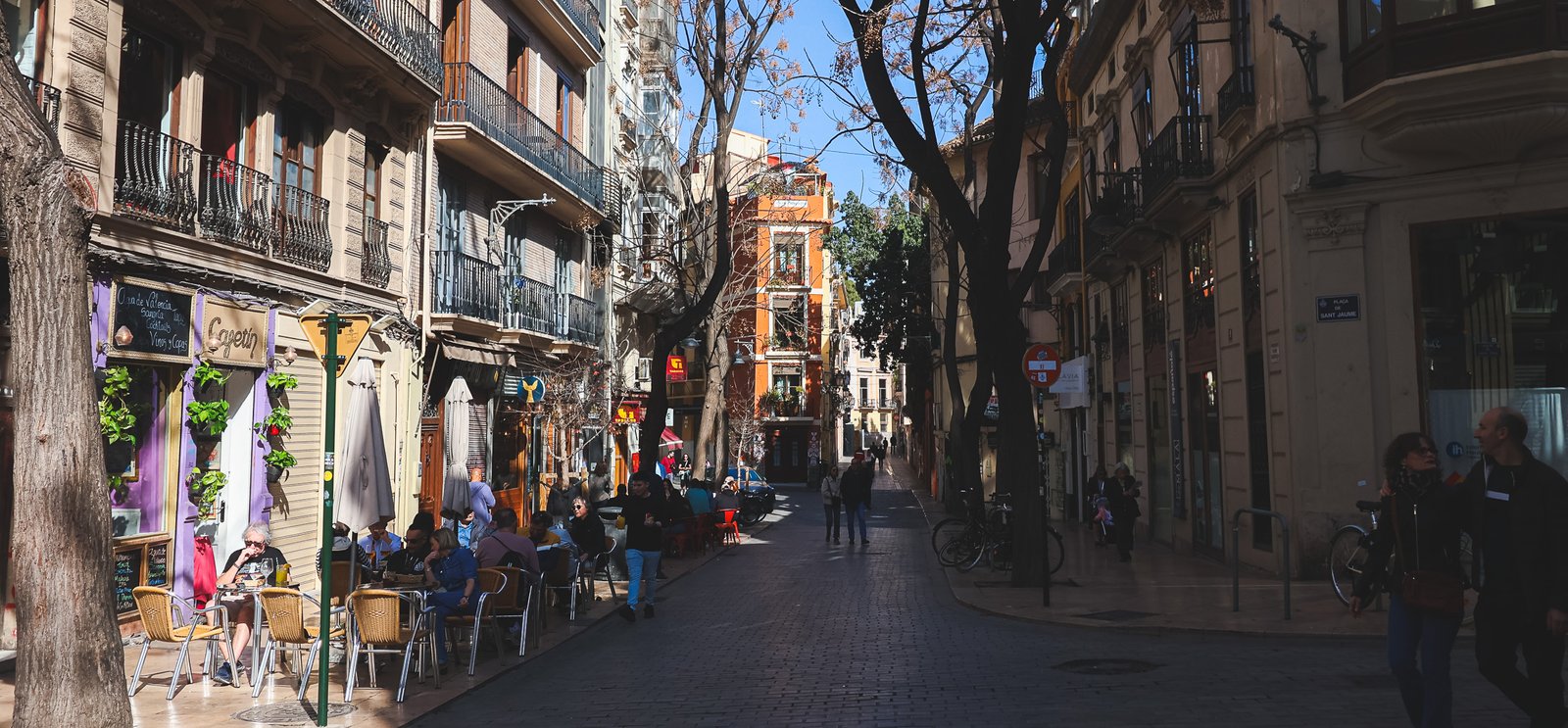
El Carmen, the quarter where stretches of the Islamic wall survive inside later buildings. Photo by Alis Monte [CC BY-SA 4.0], via Connecting Valencia
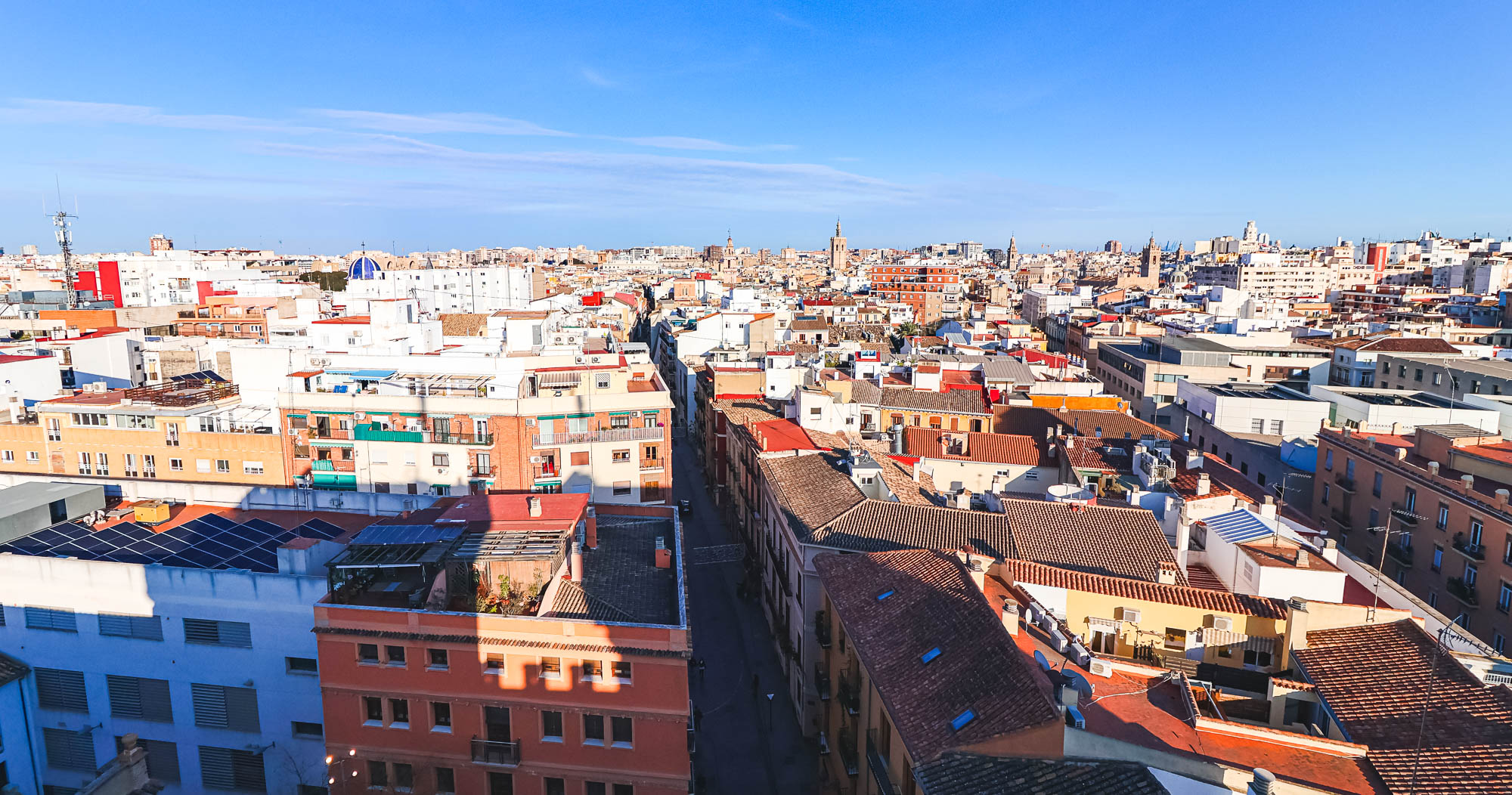
El Carmen seen from the Quart Towers (Torres de Quart). Photo by Alis Monte [CC BY-SA 4.0], via Connecting Valencia
Al-Andalus also left Valencia its irrigated plain and the institution that runs it. Irrigators’ tribunals date back to the 9th–13th centuries, and the Water Tribunal of the Plain of Valencia (Tribunal de las Aguas) still meets every Thursday at 12:00 at the Cathedral’s Apostles’ Door (Puerta de los Apóstoles). Its eight elected farmers settle disputes orally, in a vocabulary full of Arabic words, on behalf of more than 11,000 members of nine canal communities. UNESCO listed it as Intangible Cultural Heritage in 2009; see our UNESCO heritage in Valencia guide. Visit València calls it the oldest active court in the world, a claim that is popular rather than proven.
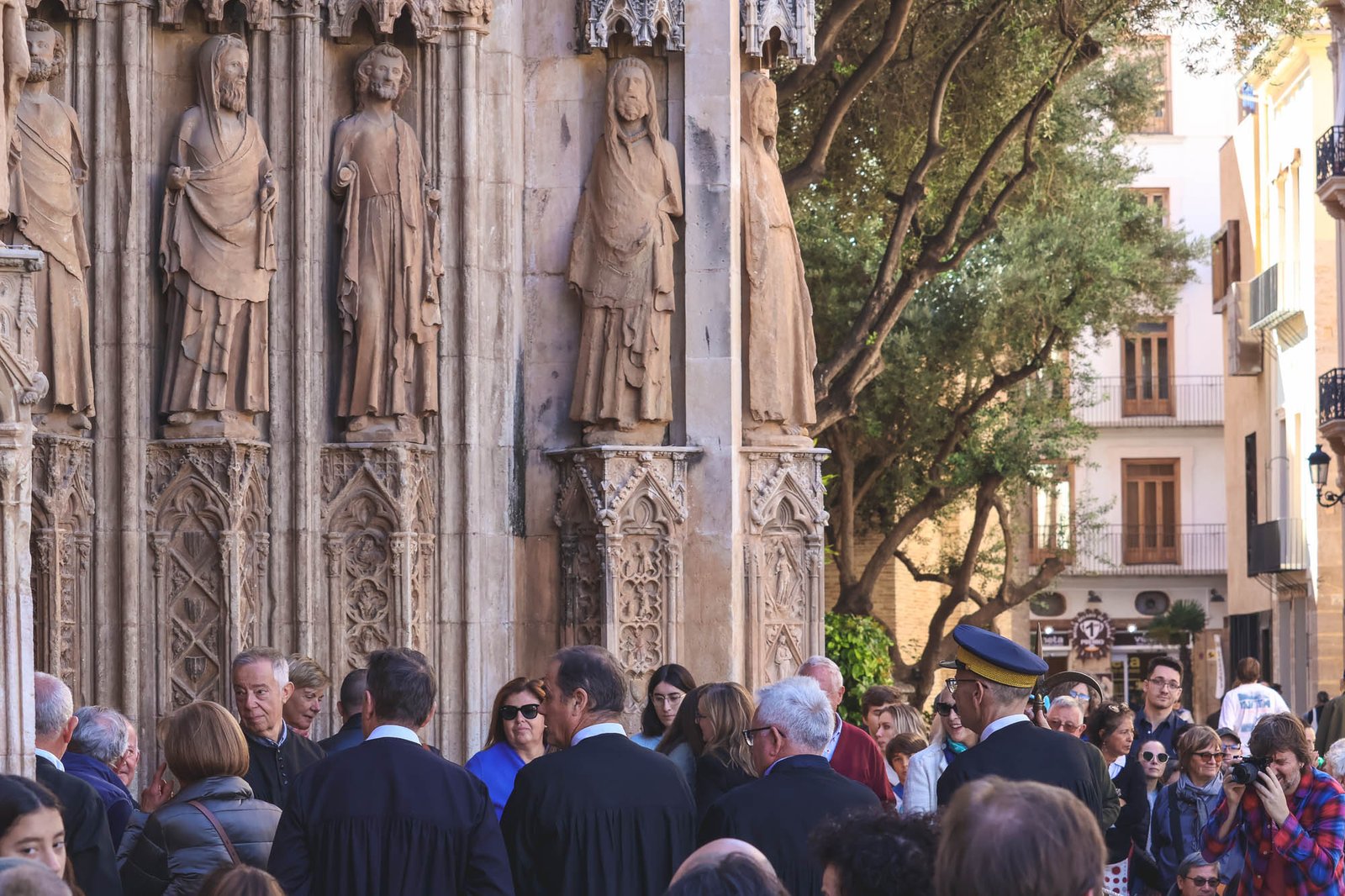
The Water Tribunal (Tribunal de las Aguas) in session at the Cathedral’s Apostles’ Door. Photo by Alis Monte [CC BY-SA 4.0], via Connecting Valencia
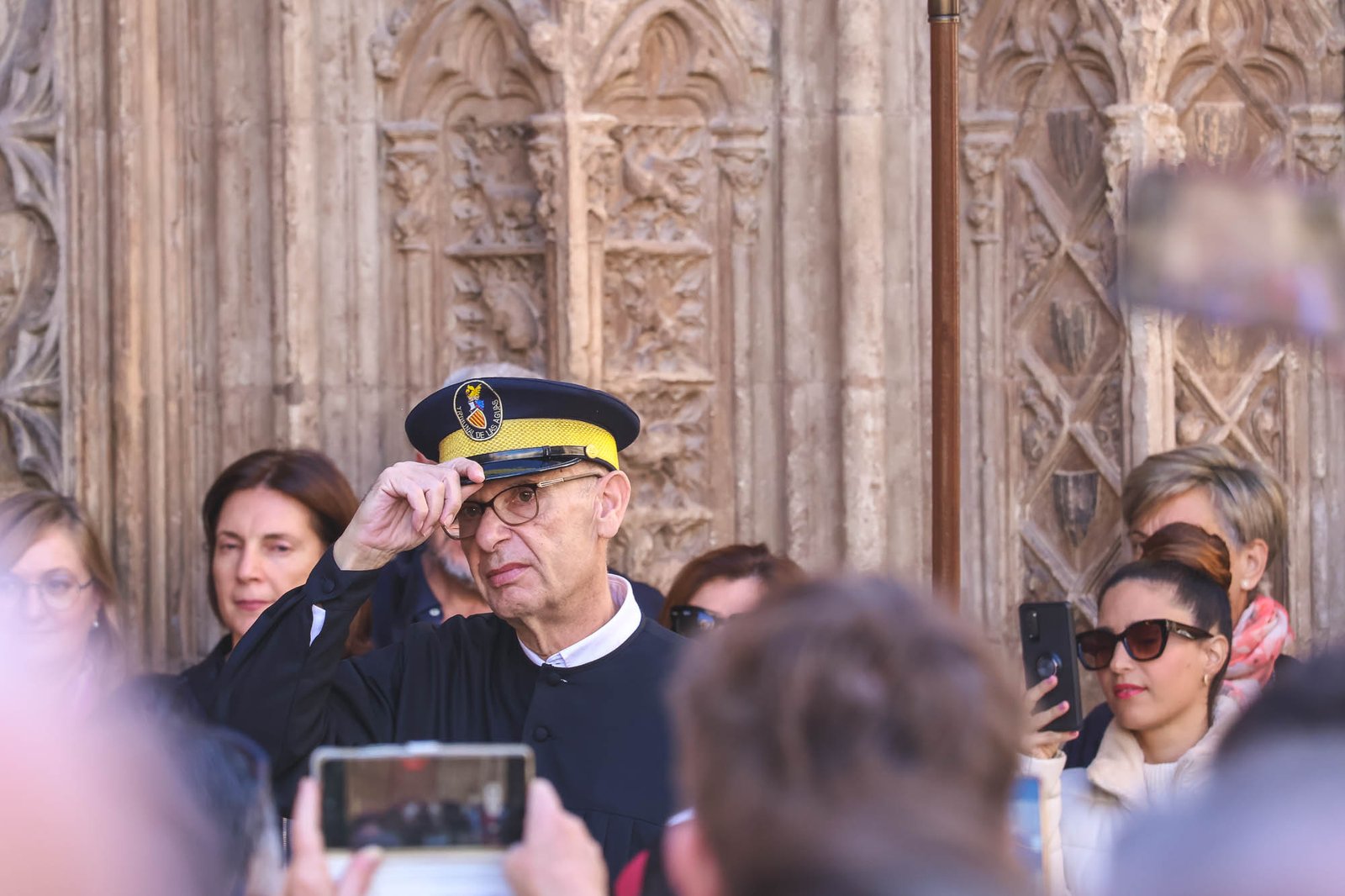
A member of the Water Tribunal (Tribunal de las Aguas). Photo by Alis Monte [CC BY-SA 4.0], via Connecting Valencia
Where to See Islamic Valencia Today
- Tossal Gallery (Galería del Tossal), under Plaza del Tossal: 20 m / 66 ft of wall that the city dates to the 12th century, a square tower and arches over the Rovella canal.
- Angel Tower (Torre del Ángel): an 11th-century wall tower, now built into housing.
- Portal de Valldigna and El Carmen: further fragments of the wall in the old town.
- Water Tribunal (Tribunal de las Aguas): every Thursday at 12:00 at the Cathedral’s Apostles’ Door (Puerta de los Apóstoles).
- Russafa: the district named after al-Rusafa, Abd Allah al-Balansi’s country palace.
El Cid in Valencia, 1094–1102
Rodrigo Díaz de Vivar, born around 1043, took his nickname from the Arabic sayyid, “lord”. A Castilian knight who fought for Christian and Muslim rulers alike, he besieged Valencia for months until it surrendered in June 1094; sources disagree on whether the day was the 15th or the 17th. On 21 October 1094 he defeated an Almoravid army at Quart, just west of the city, and he ruled Valencia until his death in July 1099. His widow Jimena held it until 1102, then evacuated the Christians and set the city on fire before the Almoravids arrived. The heroic legends, including the dead Cid tied to his horse to win one last battle, grew after his death and are poetry, not history.
Nothing from his rule survives above ground; the History Museum of Valencia (Museo de Historia de Valencia) covers the period, and the Islamic wall he besieged is listed above.
Jaume I and the Kingdom of Valencia, 1238
King Jaume I of Aragon, called the Conqueror, entered Valencia on 9 October 1238, and the main mosque was dedicated that day as the cathedral. He made the conquered lands a separate kingdom with its own laws rather than annexing them to Aragon or Catalonia; today’s Comunidad Valenciana is its heir. The first local code followed in 1238, and in 1261 the king swore the Furs, Valencia’s charter of laws, before the Valencian Corts. Every later king had to swear them within a month of his accession. The Generalitat describes the Furs as the first legislative text of its kind in the Iberian Peninsula.
The conquest is still celebrated. The 9 d’Octubre, first held in 1338 for the centenary, is now the Día de la Comunidad Valenciana. At noon the Reial Senyera, the royal banner, is lowered from the City Hall balcony on ropes, because since 1365 it may bow to no one, and a procession carries it to the statue of Jaume I on Plaza de Alfonso el Magnánimo.
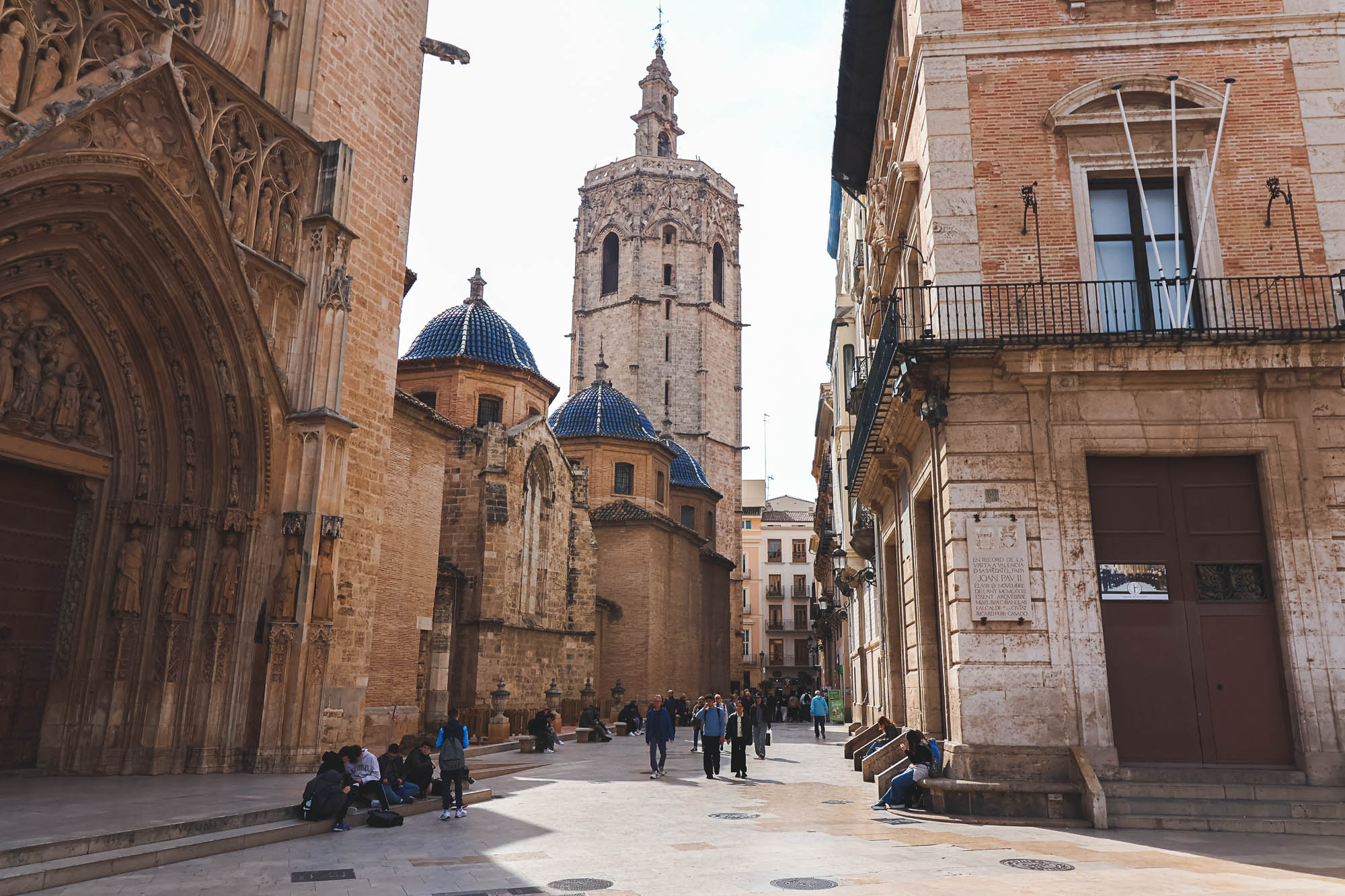
The Micalet (Torre del Miguelete), the Cathedral’s bell tower, begun in 1381. Photo by Alis Monte [CC BY-SA 4.0], via Connecting Valencia
On 22 June 1262 Bishop Andreu d’Albalat laid the first stone of the present Valencia Cathedral on the site of the mosque. The Apostles’ Door followed in 1300, the chapter house, now the Holy Chalice Chapel (Capilla del Santo Cáliz), in 1356, and the Micalet bell tower in 1381. The agate chalice arrived in 1437; its identification with the Holy Grail is a matter of faith and tradition.
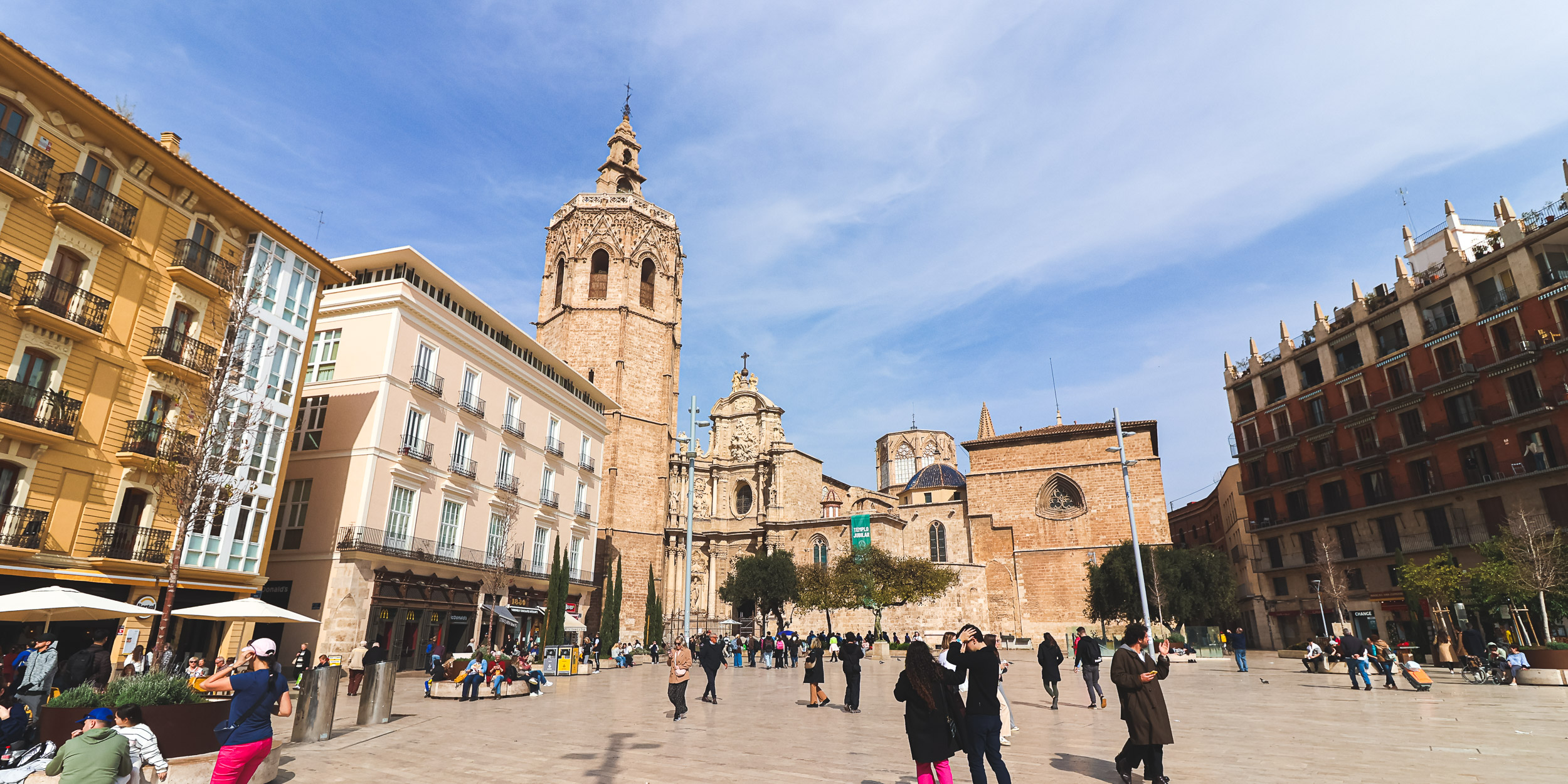
Valencia Cathedral (Catedral de Valencia), built on the site of the city’s main mosque after 1238. Photo by Alis Monte [CC BY-SA 4.0], via Connecting Valencia
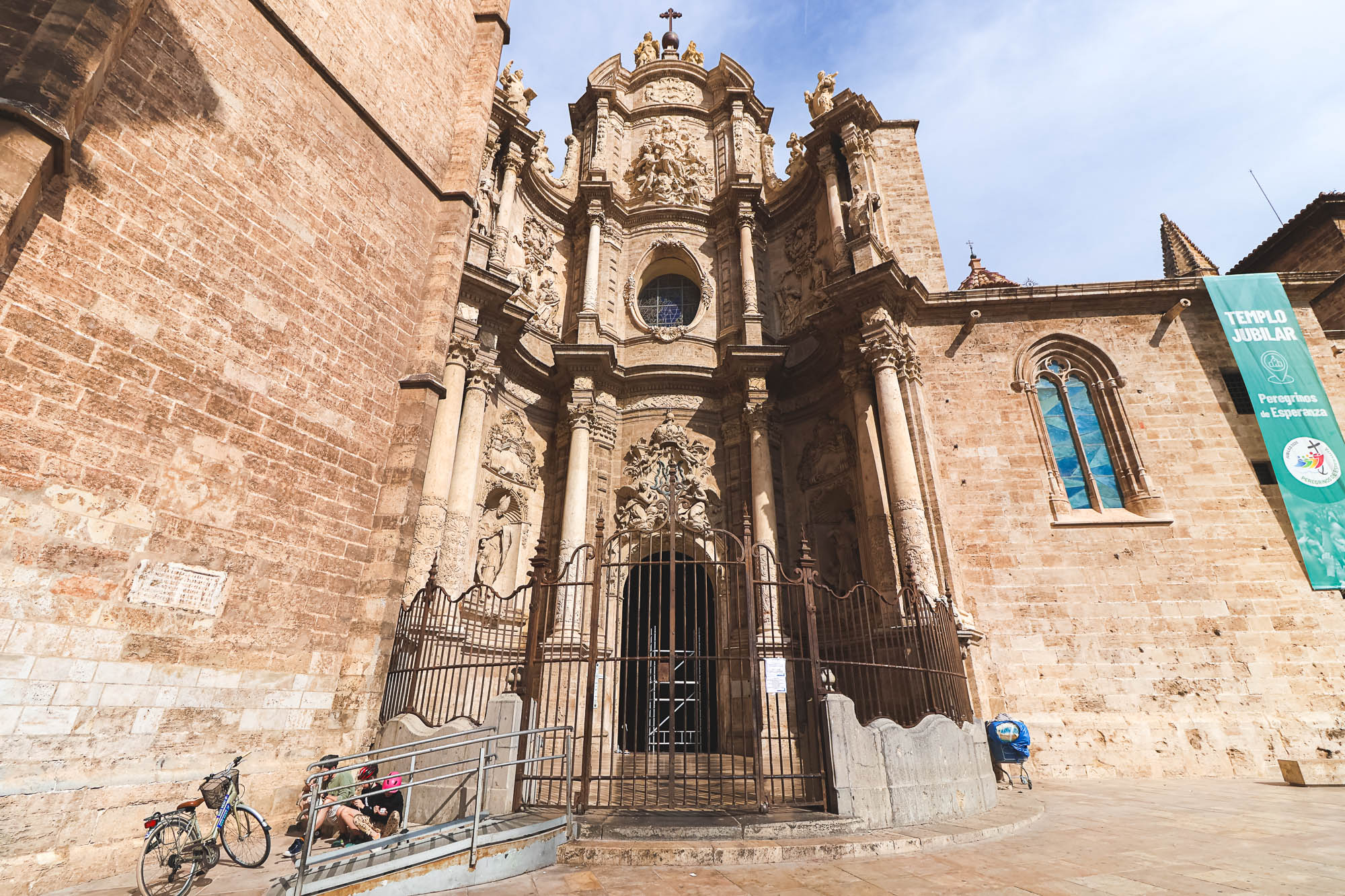
Main entrance to Valencia Cathedral (Catedral de Valencia). Photo by Alis Monte [CC BY-SA 4.0], via Connecting Valencia
Pedro I of Castile besieged the city twice in the 14th century without taking it, which earned Valencia the title “Dos Veces Leal” (“twice loyal”), the two L’s on its coat of arms. In 1356 Pere IV began a new Christian wall about 4 km / 2.5 mi long with twelve gates, enclosing about 142 ha / 351 acres. Only two of its main gates survive: the Serranos Towers, built by Pere Balaguer in 1392–1398, and the Quart Towers (Torres de Quart).
Where to See Medieval Valencia Today
- Valencia Cathedral (Catedral de Valencia): the Apostles’ Door (1300), the Holy Chalice Chapel (Capilla del Santo Cáliz) and the Micalet (Miguelete) bell tower (1381).
- City Hall (Ayuntamiento de Valencia): the balcony from which the Reial Senyera is lowered every 9 October.
- Statue of Jaume I, Plaza de Alfonso el Magnánimo: where the 9 d’Octubre procession ends.
- Serranos Towers (Torres de Serranos): the main northern gate of the 1356 wall, built 1392–1398.
The 15th-Century Golden Age
In the 15th century Valencia became the most important city of the Crown of Aragon, rich from silk, trade and banking. The city opened its municipal bank, the Taula de Canvis, in 1407. The Quart Towers went up between 1441 and 1460 and still carry the marks of French cannon from 1808.
The age’s monument is the Silk Exchange (Lonja de la Seda), begun in 1482 by Pere Compte and Joan Ivarra and completed with the Consulate of the Sea in 1548. Its trading hall rests on twisted columns almost 16 m / 52 ft high, and UNESCO listed it in 1996.
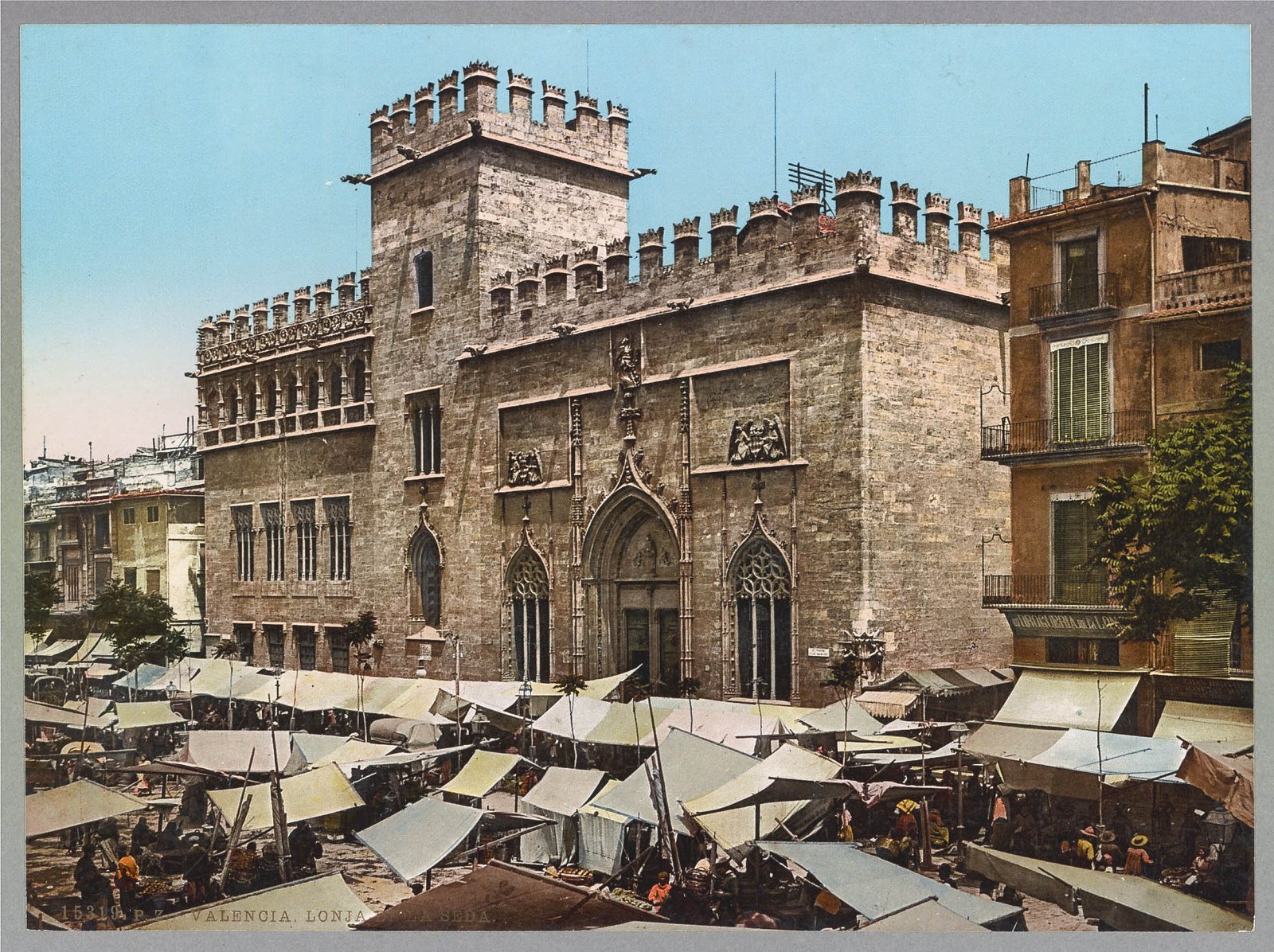
The Silk Exchange (Lonja de la Seda) in an 1890 print. 1890 Photoglob Co., publisher, Public domain, via Wikimedia Commons
Valencian literature had its classical moment at the same time. Ausiàs March (1400–1459) left 128 poems, and Joanot Martorell’s chivalric novel Tirant lo Blanch, written in 1460–1464, was printed in Valencia in 1490. Printing reached the city in 1473, and the Trobes en lahors de la Verge Maria of 1474 was the first literary book printed in the Iberian Peninsula. The only surviving copy belongs to the University of Valencia. Two Borja popes came from the kingdom: Callixtus III (1455–1458), born near Xàtiva, and Alexander VI (1492–1503), born in Xàtiva itself.
Where to See Golden Age Valencia Today
- Silk Exchange (Lonja de la Seda): the trading hall of twisted columns and the Consulate of the Sea, a UNESCO World Heritage Site.
- Quart Towers (Torres de Quart): the western gate, built 1441–1460.
- Palace of the Generalitat (Palau de la Generalitat), Calle Caballeros 2: the Gothic seat of the Kingdom’s Generalitat, with free guided visits on weekday mornings by appointment.
- Xàtiva: the birthplace of Alexander VI, south of Valencia.
The Germanies, the Moriscos and the End of the Furs
In 1519 Valencia’s guild masters and journeymen swore a brotherhood, the Germania, later joined by farmers of l’Horta and other towns. Led by a Board of Thirteen, it set out to reform city government, taxes and justice, and controlled the city in 1519–1520. Royal and noble troops crushed it in 1521–1522, and its radical leader Vicent Peris was killed in March 1522. The viceroy Germaine of Foix followed with harsh repression, and Castilian spread at court.
The next blow fell on the Moriscos, Muslims forcibly converted to Christianity. On 22 September 1609 the viceroy proclaimed their expulsion, giving them three days to be ready to go to the ports. The 17th century brought economic crisis and the plague of 1647.
When Carlos II died without an heir in 1700, the War of the Spanish Succession set Philip of Anjou against Archduke Charles. After the Bourbon victory at Almansa on 25 April 1707, Philip V’s Nueva Planta decree of 29 June 1707 abolished the Furs, citing rebellion and “right of conquest”. In Xàtiva, which he had ordered burned on 19 June 1707, his portrait still hangs upside down in the Fine Arts Museum.
Where to See Early Modern Valencia Today
- Xàtiva Fine Arts Museum (Museo de Bellas Artes de Xàtiva), in the Casa de l’Ensenyança: the portrait of Philip V, hung upside down since the late 1950s in memory of the 1707 burning of the town.
The 19th Century: Sieges, Silk and the Fall of the Walls
Valencia rose against Napoleon on 23 May 1808, roused by a man remembered as El Palleter, and on 28 June the city held off Marshal Moncey’s army at the Quart gate. Marshal Suchet took it on 9 January 1812 and left in July 1813. A year later Fernando VII stopped at the Palacio de Cervelló on his way back to Madrid and annulled the liberal Constitution of 1812.
On 20 February 1865 the civil governor Cirilo Amorós ordered the medieval walls torn down. The work was meant to give jobs to workers left idle by the crisis in the silk industry, and to let air into a crowded city. The wall’s line survives as the ring of streets from Guillem de Castro to Colón, and pieces can be seen in the Wall Room of the IVAM art museum. Beyond it grew the Eixample, the planned grid of new streets. From the 1870s the Renaixença revived Valencian as a literary language, and the 1909 Regional Exhibition beside the Alameda showed off the region’s farming and industry.
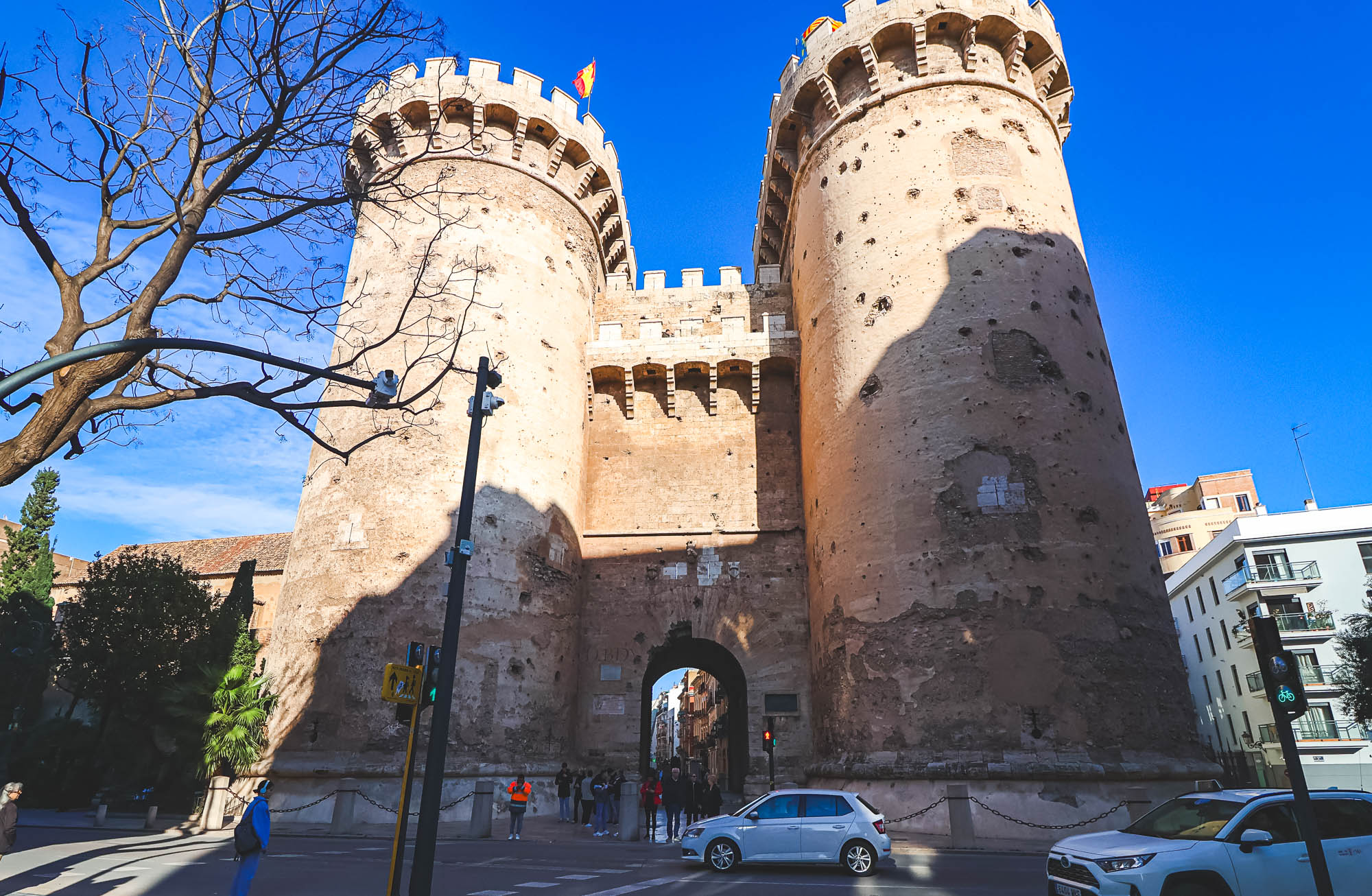
The Quart Towers (Torres de Quart), where the city held off Moncey’s army in 1808. Photo by Alis Monte [CC BY-SA 4.0], via Connecting Valencia
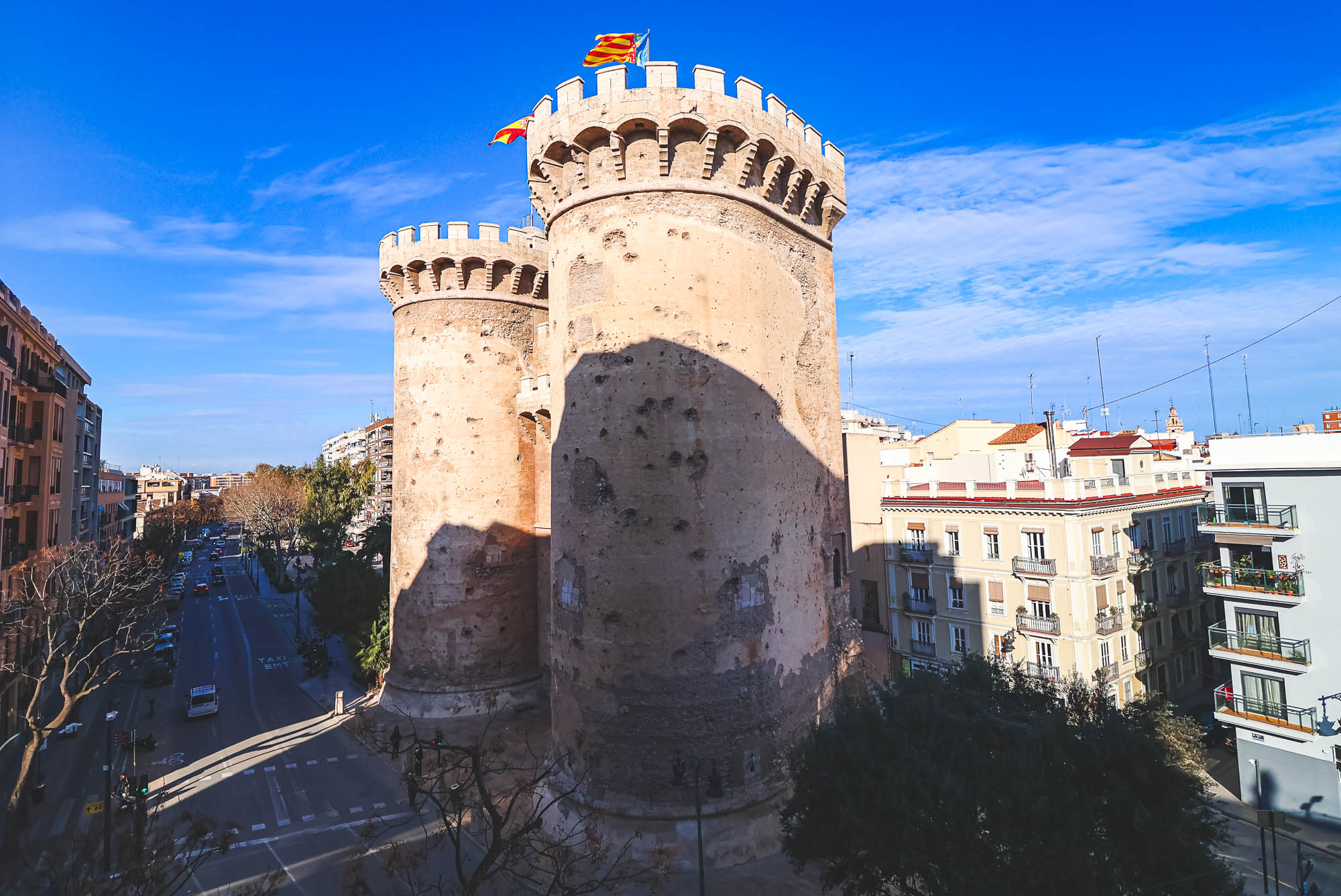
Quart Towers (Torres de Quart) from a nearby building. Photo by Alis Monte [CC BY-SA 4.0], via Connecting Valencia
Where to See 19th-Century Valencia Today
- Quart Towers (Torres de Quart): marks of French cannon from 1808 on the outer face.
- Palacio de Cervelló: where Fernando VII stayed in 1814 before annulling the Constitution of 1812.
- The ring of streets from Guillem de Castro to Colón: the line of the medieval wall demolished from 1865.
- IVAM art museum: pieces of the medieval wall in its Wall Room.
Capital of the Republic, the 1957 Flood and the Turia Gardens
When Franco’s forces threatened Madrid, the Republican government moved to Valencia on 7 November 1936 and stayed until 31 October 1937. The city dug more than 200 air-raid shelters, and Prado masterpieces were stored inside the Serranos Towers. Valencia surrendered on 30 March 1939, and the dictatorship that followed banned parties, punished expressions of Valencian identity, and brought more than a decade of rationing.
On 14 October 1957 the Turia burst its banks in the worst flood in the city’s history. The response was the Plan Sur, approved by law on 23 December 1961, which diverted the river into a new channel south of the city. A motorway was planned for the empty riverbed, but residents campaigned against it, and the old bed became the Turia Gardens (Jardín del Turia): more than 9 km / 5.6 mi of parks and paths from the Bioparc to the City of Arts and Sciences (Ciudad de las Artes y las Ciencias), crossed by 18 bridges. The oldest, the Gothic Trinity Bridge (Puente de la Trinidad), dates from the 15th century, and the Palau de la Música stands in the riverbed.
After Franco’s death came the 1978 Constitution, and the 1982 Statute of Autonomy created the Comunidad Valenciana, with the Reial Senyera as its flag. Valencian is the region’s own language, co-official with Castilian, and since 1998 the Acadèmia Valenciana de la Llengua has set its standard.
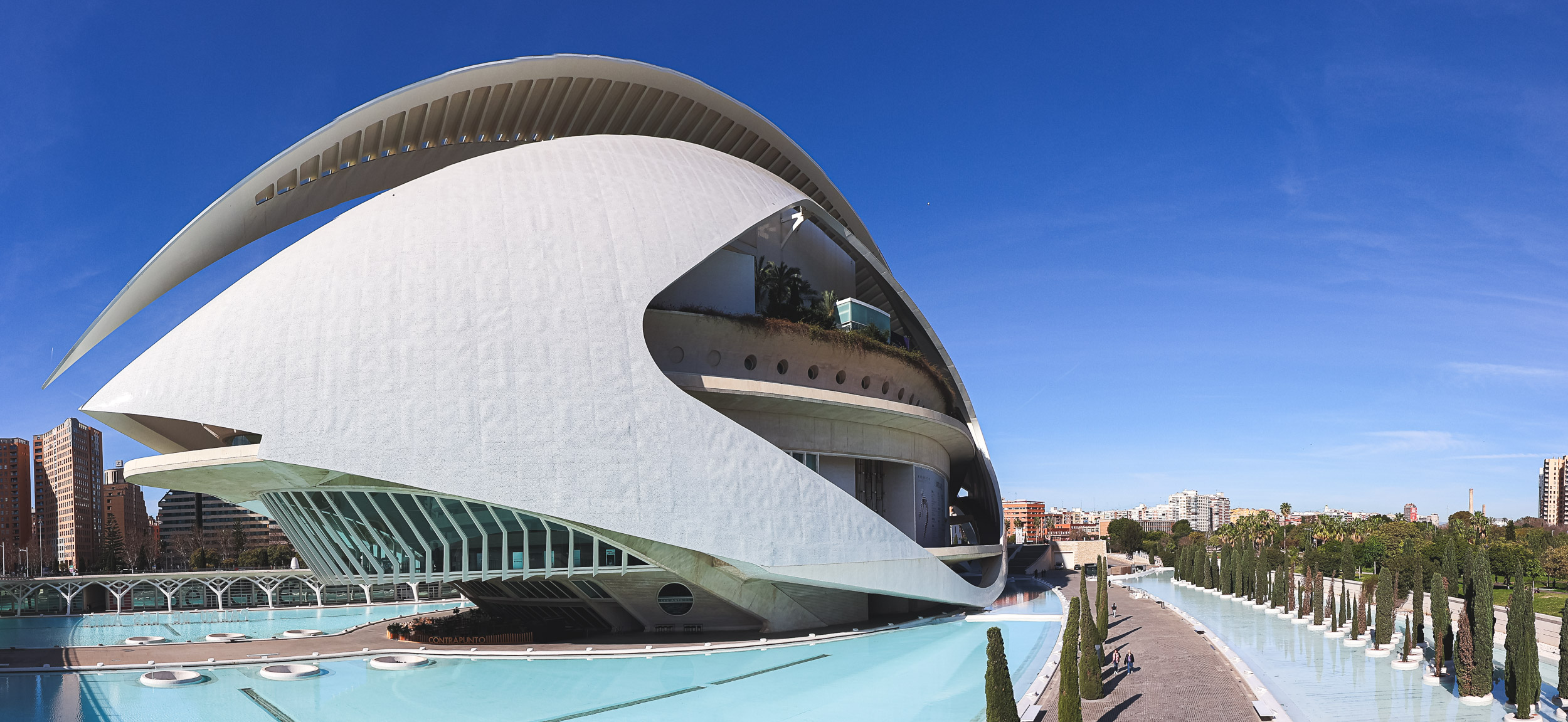
Queen Sofia Palace of Arts (Palacio de las Artes Reina Sofía) in the former Turia riverbed, now the Turia Gardens (Jardín del Turia). Photo by Alis Monte [CC BY-SA 4.0], via Connecting Valencia
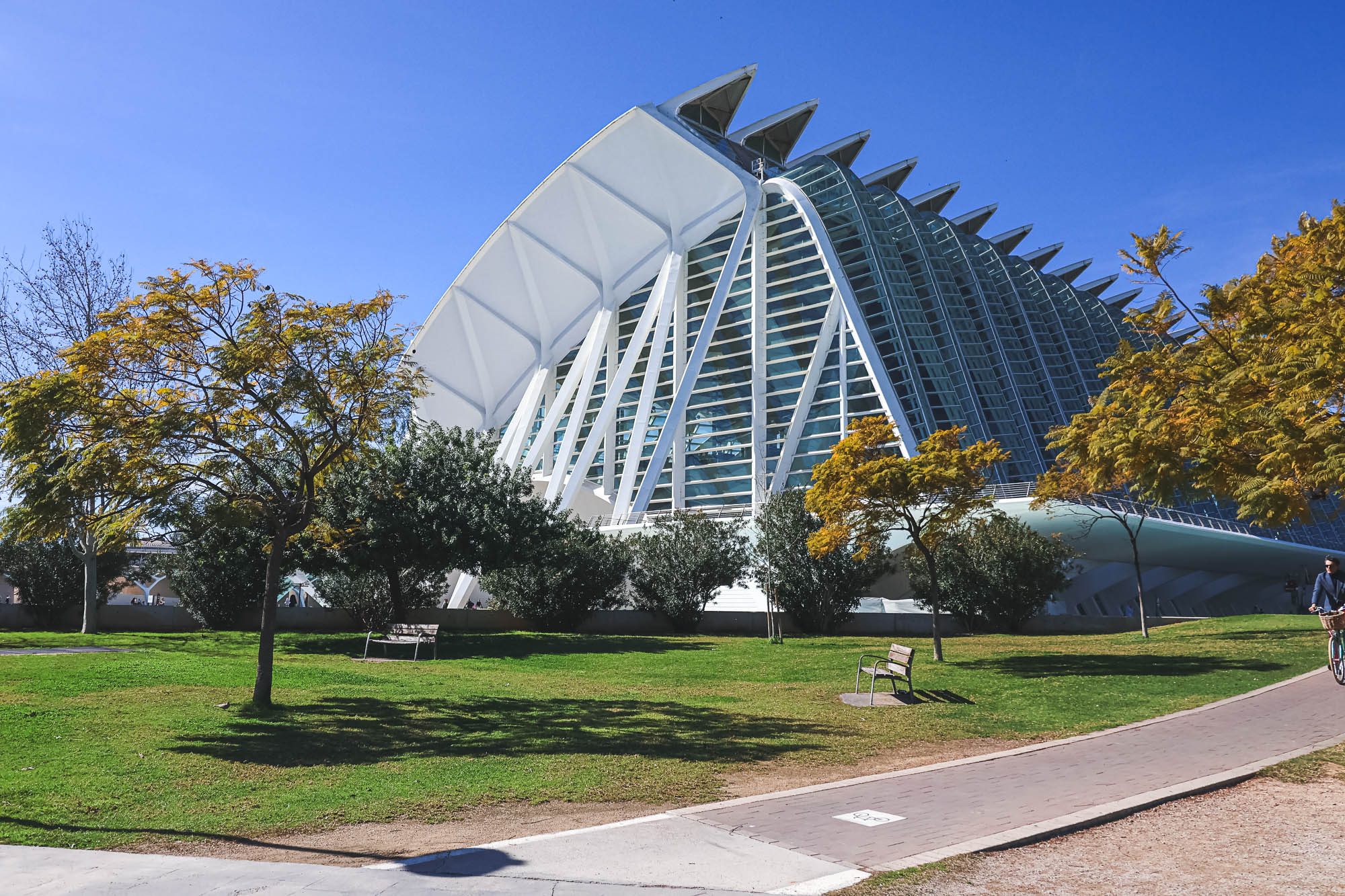
Science Museum (Museo de las Ciencias) seen from the Turia Gardens (Jardín del Turia). Photo by Alis Monte [CC BY-SA 4.0], via Connecting Valencia
Where to See 20th-Century Valencia Today
- Palau de Benicarló (Palacio de Benicarló): the Republican government’s receptions in 1936–1937, now the seat of the Corts Valencianes.
- Serranos Towers (Torres de Serranos): where Prado masterpieces were stored during the Civil War.
- Turia Gardens (Jardín del Turia): the old riverbed, from the Bioparc to the City of Arts and Sciences.
- Trinity Bridge (Puente de la Trinidad): the oldest of the 18 bridges, 15th-century Gothic.
- Palau de la Música: the concert hall in the riverbed.
Valencia Today
The riverbed turned into the city’s showpiece. Santiago Calatrava’s City of Arts and Sciences opened with the Hemisfèric (Hemisférico) on 16 April 1998, and Félix Candela designed the roofs of the Oceanogràfic (Oceanográfico). In 2007 Valencia hosted the 32nd America’s Cup, the first held in Europe, when the Swiss team Alinghi beat Emirates Team New Zealand 5–2. UNESCO inscribed the Fallas in 2016, and the European Commission named Valencia European Green Capital for 2024.
That same year brought grief. On 29 October 2024 a DANA, a cut-off low-pressure system, caused catastrophic flash floods across the province of Valencia, and more than 220 people died. The worst-hit towns lay in l’Horta Sud, southwest of the city, among them Paiporta, Catarroja, Alfafar and Massanassa.
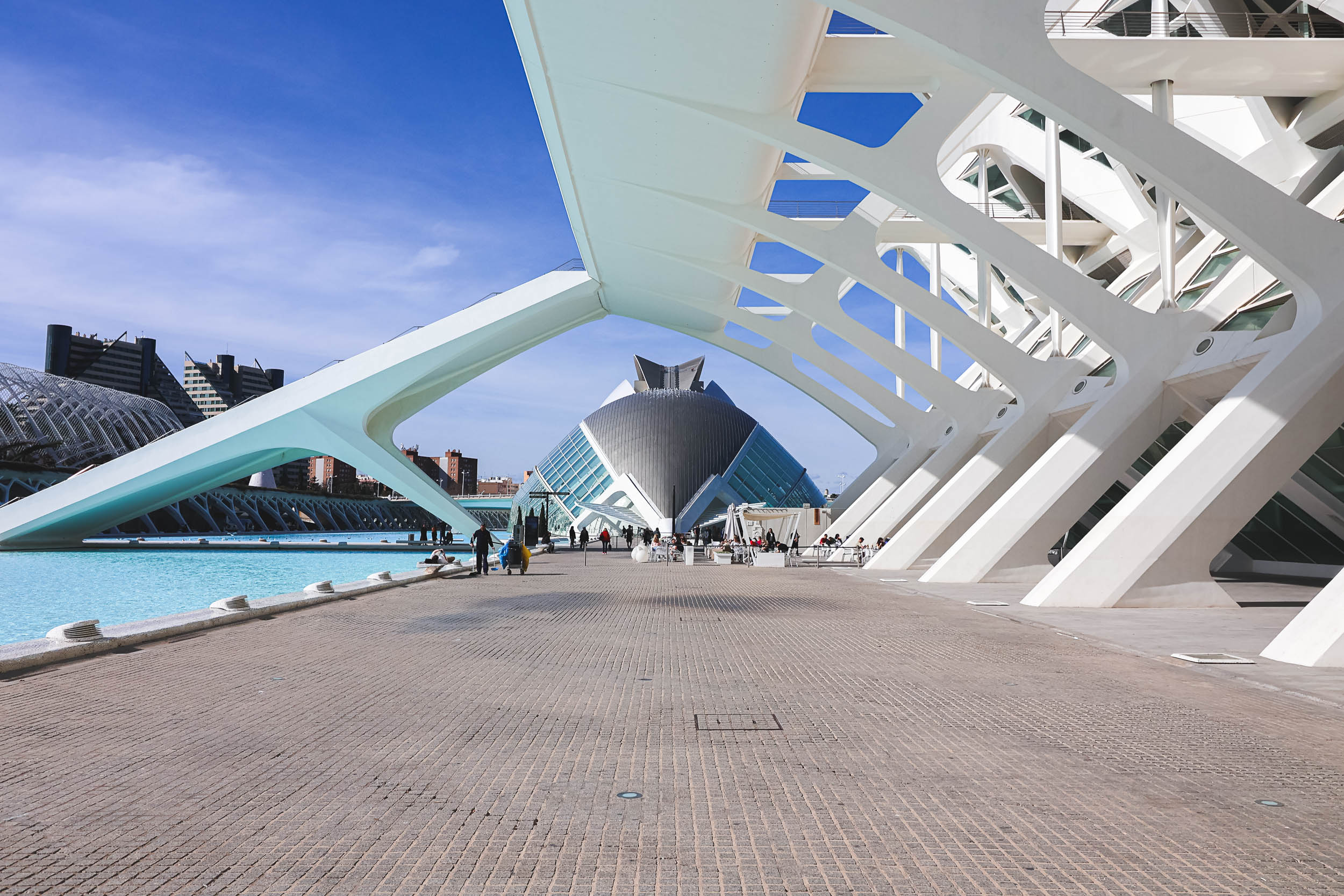
City of Arts and Sciences (Ciudad de las Artes y las Ciencias). Photo by Alis Monte [CC BY-SA 4.0], via Connecting Valencia
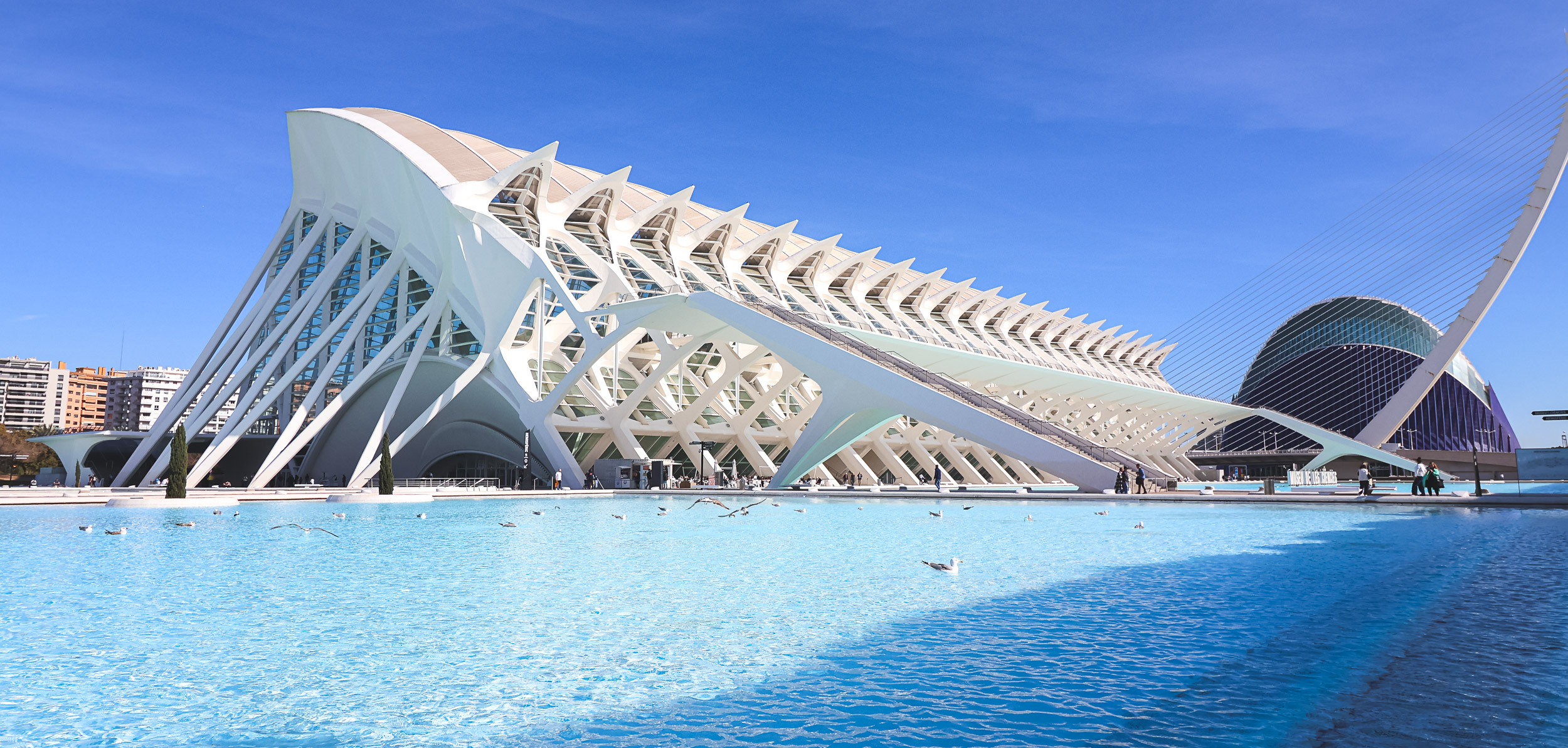
Science Museum (Museo de las Ciencias), City of Arts and Sciences. Photo by Alis Monte [CC BY-SA 4.0], via Connecting Valencia
Where to See Modern Valencia Today
- City of Arts and Sciences (Ciudad de las Artes y las Ciencias): Santiago Calatrava’s complex at the seaward end of the Turia Gardens, with the Hemisfèric (Hemisférico) and Félix Candela’s Oceanogràfic roofs.
- Fallas: the March festival on UNESCO’s Intangible Cultural Heritage list since 2016.
Guided walks bring the old town’s layers together. Good fits include the Valencia Historical Walking Tour; the guided tour of downtown Valencia with the Silk Exchange; and the tour of the Cathedral, St Nicholas and the Silk Exchange. Find them among the Valencia tours on GetYourGuide. For the sights themselves, see our things to do in Valencia guide, and for the region’s other old towns, from Xàtiva to Peñíscola and Morella, our day trips from Valencia.
Frequently Asked Questions
How old is Valencia?
The Romans founded Valentia in 138 BC, so the city is more than 2,150 years old. Iberian towns nearby, such as Edeta at Llíria, are older.
Who founded Valencia?
Roman soldiers, settled under the consul Decimus Junius Brutus in 138 BC.
When did Jaume I conquer Valencia?
He entered the city on 9 October 1238, a date now celebrated as the Día de la Comunidad Valenciana.
Why was the Turia river moved?
After the flood of 14 October 1957, the Plan Sur diverted the river south of the city. The old riverbed became the Turia Gardens, more than 9 km / 5.6 mi long.
What is the Water Tribunal?
A court of farmers dating from al-Andalus that settles irrigation disputes orally every Thursday at 12:00 at the Cathedral's Apostles' Door. UNESCO listed it in 2009.
What does Sagunt have to do with the Punic Wars?
Hannibal's eight-month siege of Saguntum in 219 BC led Rome to declare the Second Punic War.