October 15, 2026
Altea Old Town: Church Square, Viewpoints and Directions
Architecture, Culture, Guide, History
Top attractions:
About Altea Old Town
Altea Old Town (Casco Antiguo), el Poble Antic in Valencian, climbs a hill above the middle of the bay that bears its name, from the seafront fishermen’s quarter to the blue-and-white tiled domes of its parish church. It is a planned town of the early 17th century, founded on a contract between a lord and 48 families of settlers, and its streets still follow the layout of 1617: whitewashed, cobbled and stepped lanes inside the line of the old walls, with a gate at each end and the Church Square (Plaza de la Iglesia) on the site of the vanished castle. The protected core is listed as the Renaissance Bastion and Walled Precinct (Baluarte y Recinto Renacentista), a Bien de Interés Cultural.
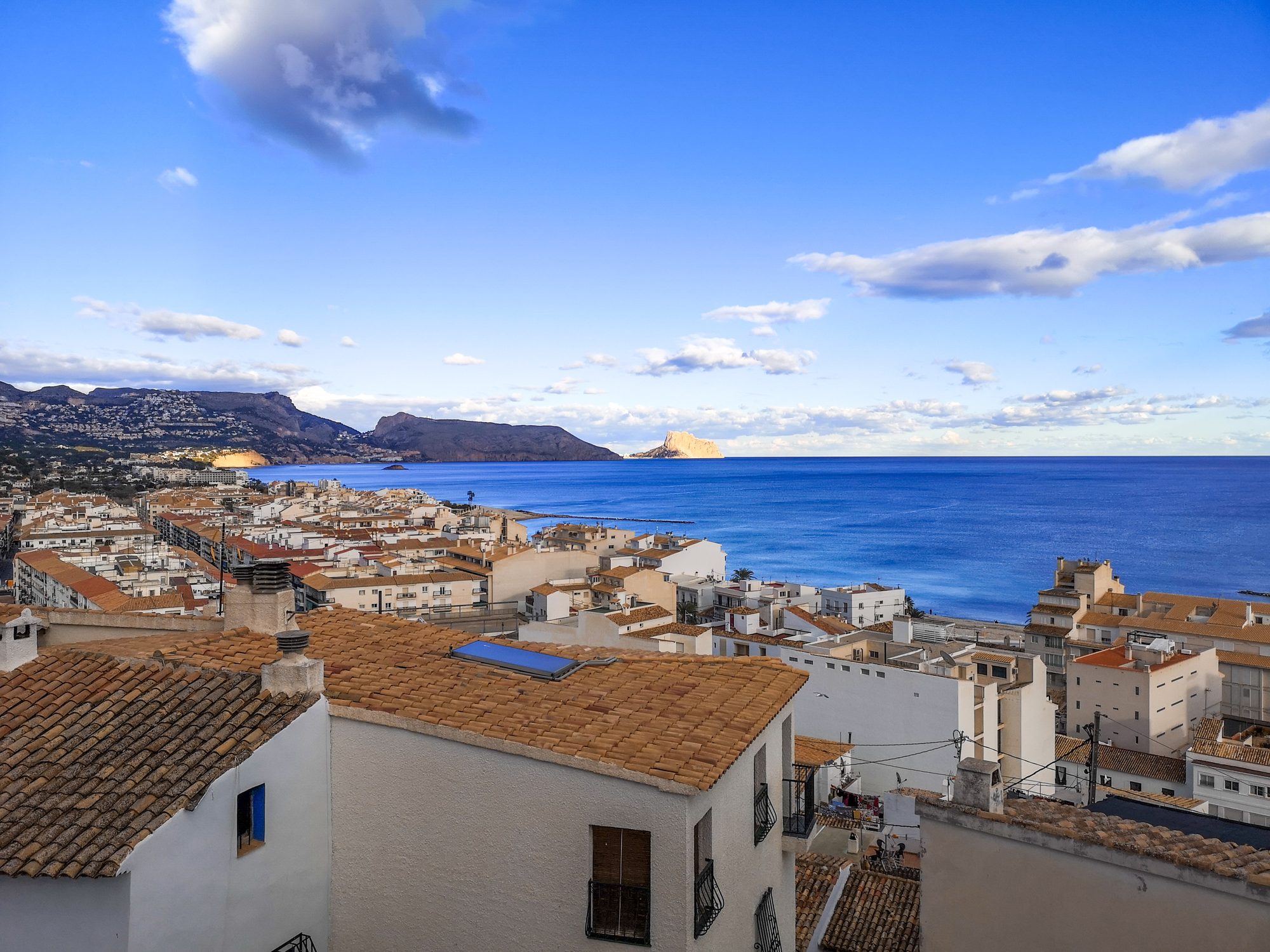
Altea’s old town climbs its hill above the bay. Photo by Alis Monte [CC BY-SA 4.0], via Connecting Valencia
Altea Old Town Details
- Location: Altea, Marina Baixa, Alicante province
- Distance from Valencia: 132 km / 82 mi, about 1 h 40 min by car
- Getting there without a car: ALSA coach from Valencia; TRAM d’Alacant Line 9 from Benidorm, about 15 min
- Main sights: Church of Our Lady of Consolation (Iglesia de Nuestra Señora del Consuelo), the church square, Portal Vell, Portal Nou, Glorieta del Maño viewpoint
- Terrain: steep, cobbled and stepped lanes
- Tourist office: Carrer Sant Pere 14, on the seafront; Altea Turismo
- Day tour from Valencia: From Valencia: Excursion to Guadalest, Altea and Admission to the Algar Waterfalls
History
Modern Altea was built from scratch. By the start of the 17th century its district had been uninhabited for more than half a century, and Francisco de Palafox, lord of Ariza, founded a new town at the farmstead (alquería) of Bellaguarda. He ringed it with walls of the kind called de casamuro, in which the reinforced outer walls of the houses formed the town wall, and the walls and castle were standing by 1604. On 11 January 1617 his brother and successor Jaime de Palafox signed the settlement charter (carta pobla) with 48 heads of family, a contract that leased out the land and confirmed Altea as the town’s name. It was part of the repopulation of the Valencian coast after the expulsion of the Moriscos in 1609; the new town itself had no Morisco population. Older traces lie outside the walls, among them a large Roman villa of the 1st and 2nd centuries AD excavated in 2022.
The walled town had two gates. The lower one, the Valencia Gate, is today’s Portal Vell, at the top of Carrer Major, facing the old royal road. As the fishermen’s quarter below the walls, the Rabal, grew in importance, the Portal Nou, or Sea Gate, was opened toward it in the mid-18th century. The castle, a square keep with three corner turrets, has gone, and the church square stands on its site. In the early 20th century Valencian painters such as Genaro Lahuerta, Joaquín Mompó and Genaro Palau came to paint the town; in the 1960s and 1970s it became a meeting place and home for artists, and painters including Benjamín Palencia, Eberhard Schlotter and Toni Miró decorated houses and restaurants, painted street murals and designed fiesta posters. The writer Gabriel Miró called Altea a “pueblo torrado al sol”, a town toasted by the sun, and the local writer Carmelina Sánchez Cutillas set her book Matèria de Bretanya in its streets.
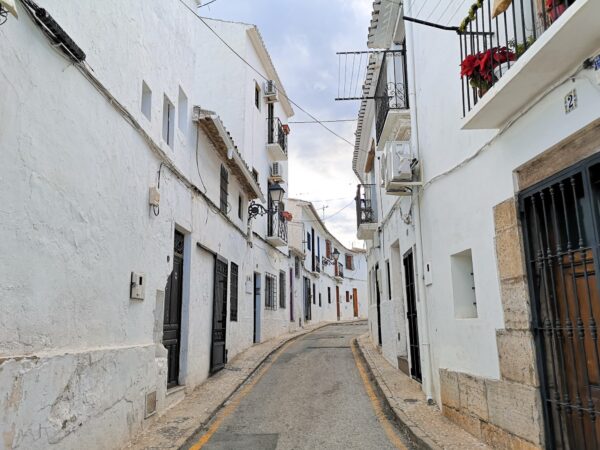
Whitewashed houses and balconies on a lane up to the church. Photo by Alis Monte [CC BY-SA 4.0], via Connecting Valencia
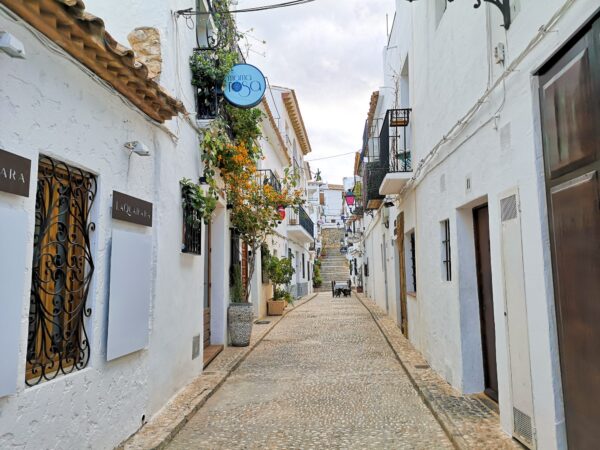
Cobbled lanes and steps inside the line of the old walls. Photo by Alis Monte [CC BY-SA 4.0], via Connecting Valencia
Church of Our Lady of Consolation
The Church of Our Lady of Consolation (Iglesia de Nuestra Señora del Consuelo; in Valencian, the Mare de Déu del Consol) crowns the hill at the highest point of the old town. It was built between 1901 and 1910, when the parish priest Juan Bautista Cremades Peiró drove the rebuilding and the town’s first church, in use since 1613, was demolished; it was consecrated in 1910 and restored in the 1980s. The master builder Adrián Vela Gadea worked from a sketch by the schoolmaster Jaime Cardona. Locals call it the church “de arriba”, the church up top.
The building is classicist, on a Latin-cross plan, with a square bell tower to the left of the façade. Its glory is the pair of domes raised on drums, one over the crossing and one over the Communion chapel, built in 1854 as the separate Capilla del Cristo and later absorbed into the church. Both are covered in blue-and-white glazed tiles laid in a scale-like pattern, which have earned them the name “las cúpulas del Mediterráneo”, the domes of the Mediterranean. They rise above the white lanes and show from the sea and from the streets below; the tourism office counts them among the icons of the Costa Blanca.
The Church Square, Gates and Viewpoints
The Church Square opens in front of the church on the site of the old castle, with a viewpoint over the bay. Carrer Major runs down from it to the Portal Vell along its original line. On the seaward side, the Portal Nou leads out to the square named after Carmelina Sánchez Cutillas, and from the Glorieta del Maño, on the northeast bastion where the lord’s residence, the Casa de la Señoría, once guarded the mouth of the river Algar, the view takes in the whole bay. Calle Salamanca, Calle Fondo and Calle Santa Bárbara keep houses of the 18th and 19th centuries, among them the Casa Cervantes, built by Francesc Martínez i Martínez, a scholar of Cervantes in the Valencian Renaixença. Below the old town, the Palau Altea arts centre has an 867-seat main hall and a glazed room looking up at the white town.
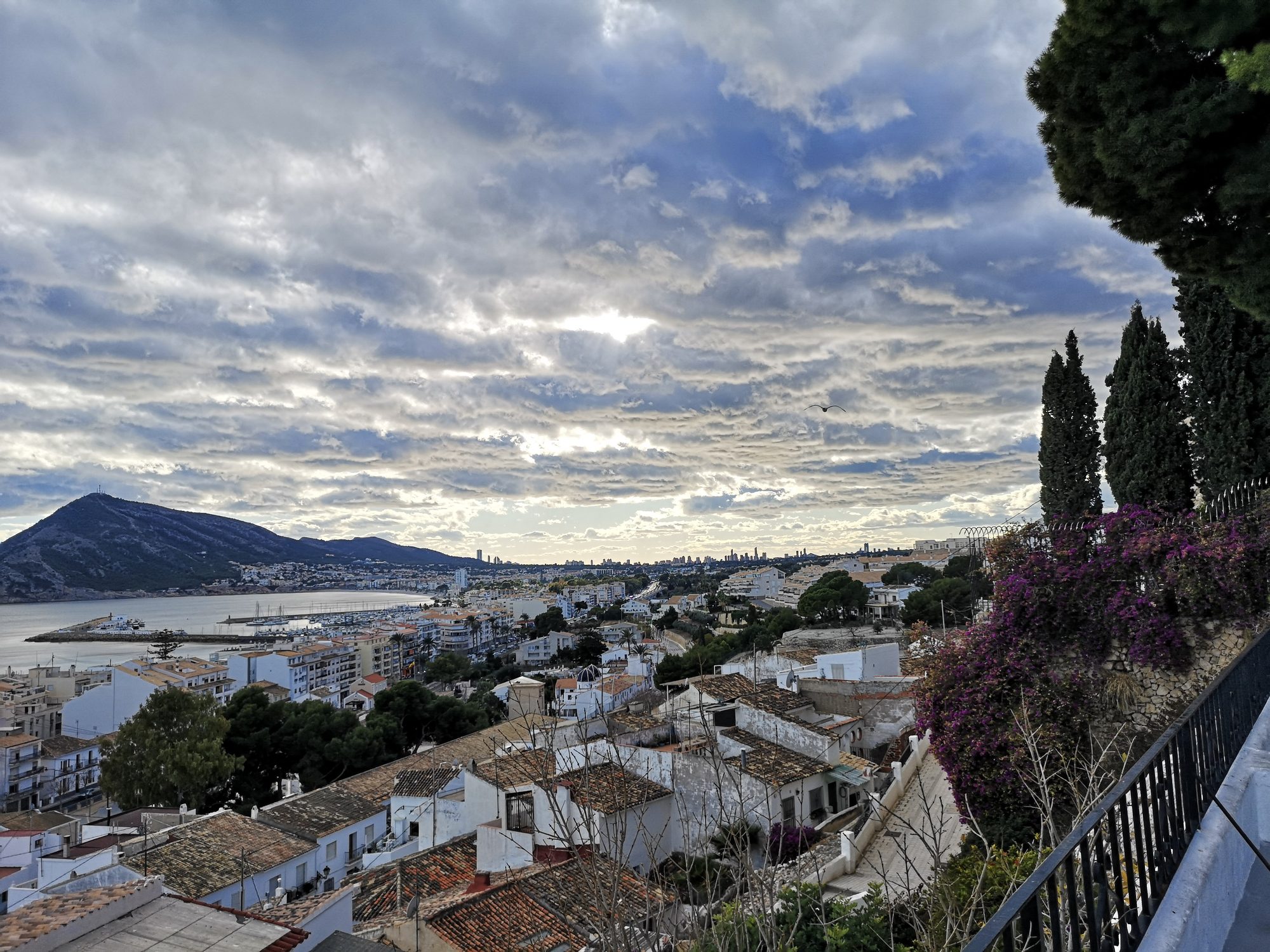
The bay of Altea from the old town, with the Serra Gelada behind. Photo by Alis Monte [CC BY-SA 4.0], via Connecting Valencia
Fiestas and Food
Altea is Valencian-speaking, and its calendar turns on its patrons. The Festes Majors, in winter and in September, honour the Cristo de la Salud, Sant Blai and the Cristo del Sagrario. In late September the Moros i Cristians in honour of Sant Blai, the town’s patron, fill the old town, and the Christian embassy (Ambaixada) and the surrender are staged in the church square. In August the Castell de l’Olla lights up the bay with fireworks launched from platforms at sea, on the Saturday nearest Sant Llorenç; dates change each year, so check the tourism office’s agenda.
The cooking rests on fish, seafood and vegetables: arròs amb fessols i polp, rice with beans and octopus; paella d’aladroc, a winter rice of fresh anchovy with cauliflower, artichoke and broad beans; caldero marinero, the pot of the crews who spent days at sea; and arròs a banda. On Thursdays the bakeries sell coca a la llumà, named after the lit cane once set beside it in the oven, along with coca farcida, a covered filled coca, and bollos de bleda, chard pasties.
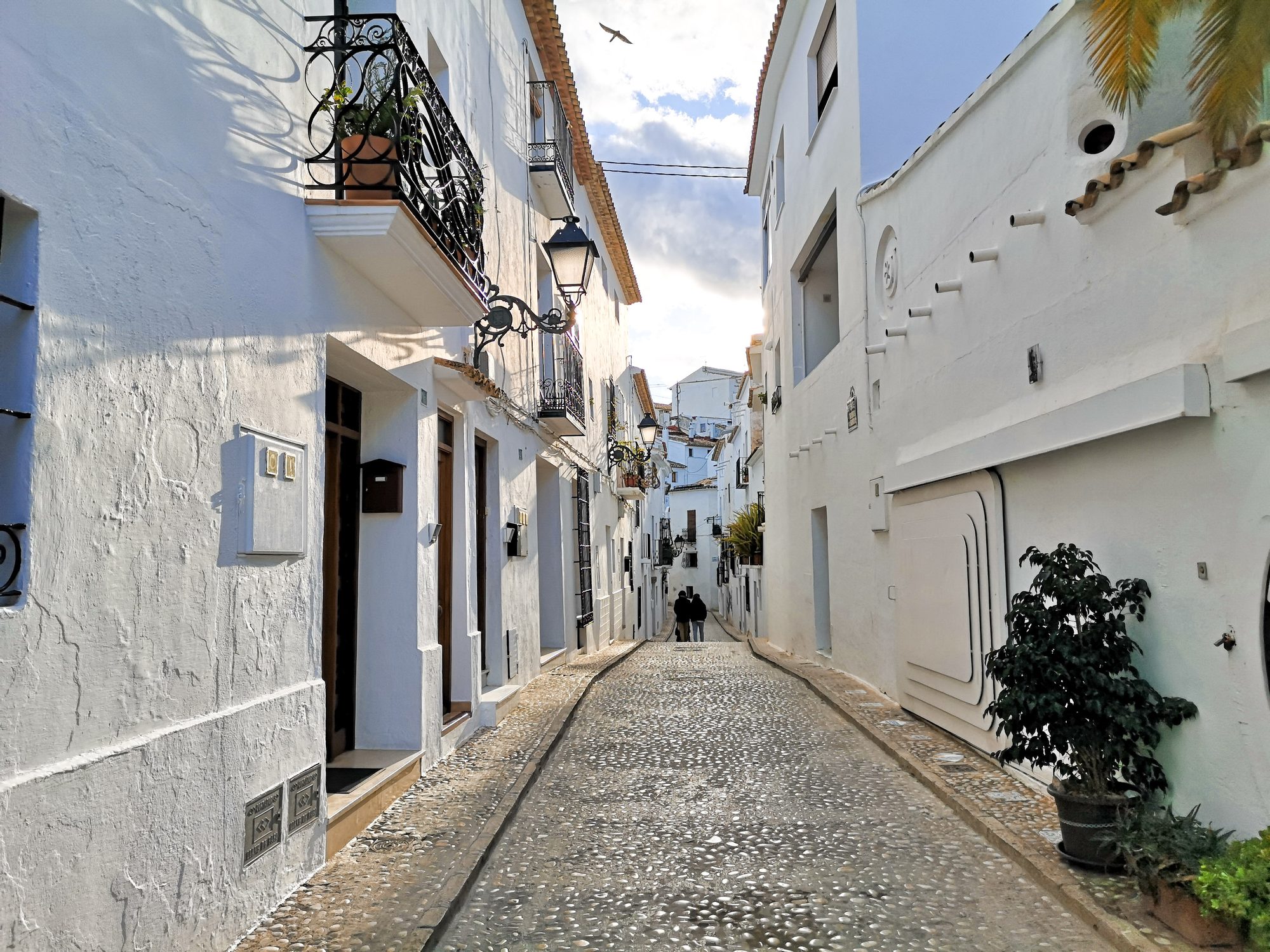
A sunlit lane in the old town. Photo by Alis Monte [CC BY-SA 4.0], via Connecting Valencia
Visiting Altea Old Town
The old town is steep, cobbled and full of steps, hard going with a wheelchair or a pushchair, so wear good shoes. Early morning and late afternoon give the best light on the white lanes and avoid the midday heat in summer. Below, the seafront has more than 6 km / 3.7 mi of coast; the beaches are pebble rather than sand, and Cap Blanch, El Bol, La Roda and L’Espigó hold the Blue Flag.
Parking: drivers are best leaving the car below the old town, whose lanes have resident-card access controls at busy times. The council car park at Basseta becomes the market ground on Tuesdays from 08:00 to 14:00; the TRAM station has a public car park; and there are private underground car parks at Plaça José María Planelles, by the town hall, and at Plaça la Pau. On foot, Carrer Sant Miquel and Carrer Sant Josep are the step-free routes up to the Church Square; every other way up is by stairways.
Getting there: Altea is about 1 h 40 min from Valencia by car. Without a car, ALSA’s coastal coaches from Valencia stop in Altea, though not every service does; check ALSA Altea–Valencia for your date. From Benidorm, the TRAM d’Alacant Line 9 takes about 15 minutes and runs roughly hourly; see the TRAM planner (Spanish). Altea is one of our day trips from Valencia, and it pairs well with Guadalest, inland, as on the From Valencia: Excursion to Guadalest, Altea and Admission to the Algar Waterfalls tour. Nearby, the Albir lighthouse hike in l’Alfàs del Pi, Calpe and the Peñón de Ifach hike lie along the same coast.
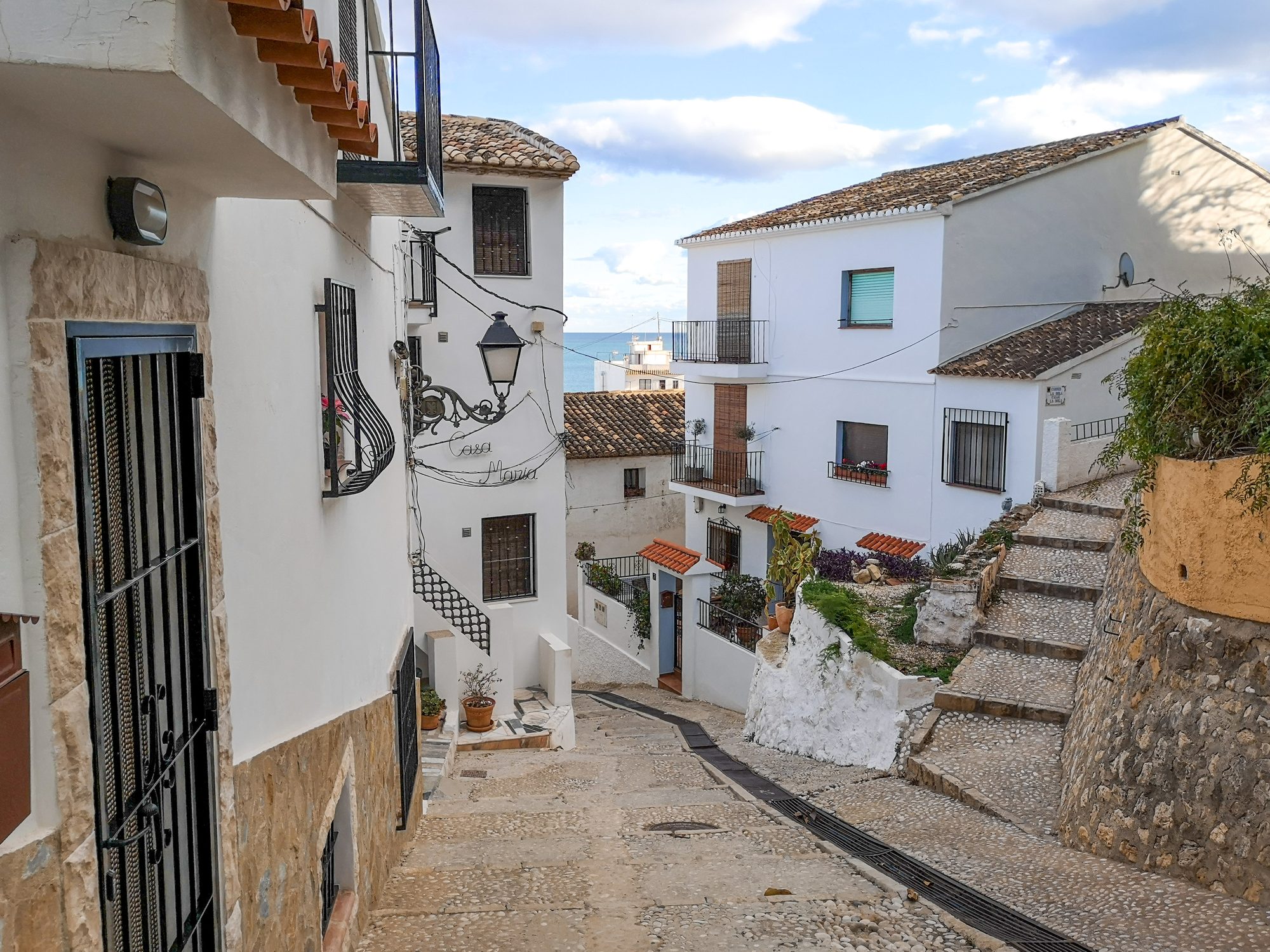
All photos by Alis Monte. If you want to collaborate, contact me on hi@connectingvalencia.com. Photo by Alis Monte [CC BY-SA 4.0], via Connecting Valencia