June 6, 2026
Local’s Guide to Arrancapins: Valencia’s Authentic Residential Barrio in Extramurs
Architecture, Culture, Guide, History
Top attractions:
About Arrancapins
Arrancapins is a dense, lived-in residential barrio in Valencia’s Extramurs district, sitting just west of the old city between the avenues of Pérez Galdós and Fernando el Católico. This is “center-adjacent” Valencia: you can walk to the Mercat Central in about 15 minutes, yet sleep on calmer, tree-lined streets where the rhythm is pleasantly ordinary. Cafés sit downstairs, bakeries and produce shops hold the corners, and the Turia Gardens edge the northern fringe for runs, bike rides, and playgrounds.
The barrio grew out of Valencia’s late-19th-century expansion (the Ensanche) after the medieval walls came down in 1865, on land where the old suburb of San Vicente once stood. It matured as a working-class neighborhood through the early 20th century, leaving behind a distinctive mix of casas baratas (affordable-housing blocks), grand brick façades, and post-war apartments. Locals are fiercely fond of it, and many in the northern half simply call the area “Abastos” after its landmark former market.
What makes Arrancapins distinct from Valencia’s tourist-heavy quarters is its everyday authenticity. There is no headline monument pulling crowds, just a genuine neighborhood that always has people on the street, an architectural standout in the Finca Roja, excellent value for money, and some of the best no-frills tapas in the city. It offers much of the appeal of nearby Ruzafa without the price tag or the queues.
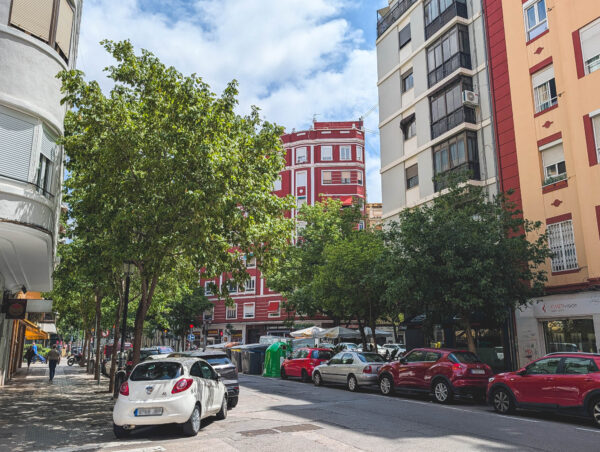
Typical architecture in Arrancapins. Photo by Alis Monte [CC BY-SA 4.0], via Connecting Valencia.
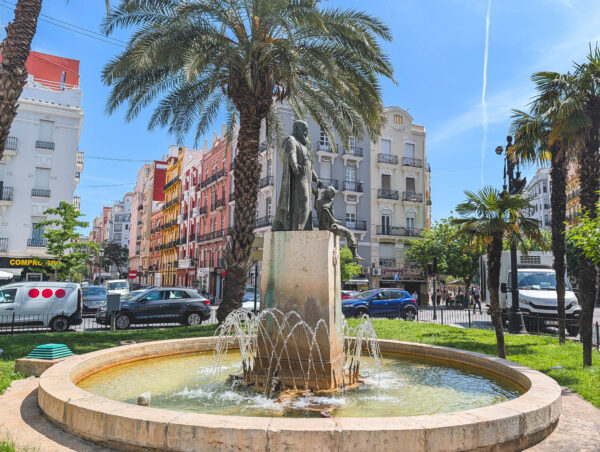
Plaza del Bisbe Amigo. Photo by Alis Monte [CC BY-SA 4.0], via Connecting Valencia.
Arrancapins Details
- District: Extramurs (District 03), Barri 4 — Arrancapins
- Region: Valencia, Valencian Community, Spain
- Postal Codes: 46007, 46008
- Coordinates: 39.4657° N, 0.3852° W
- Distance from Plaza del Ayuntamiento: 1.5 km / 0.9 mi west
- First developed: Late 19th–early 20th century (Ensanche expansion after the 1865 wall demolition)
- Population: 22,491 (2022)
- Area size: 0.874 km² / 0.34 sq mi
- Population density: ~25,700 inhabitants/km²
- Key streets & squares: Carrer d’Àngel Guimerà, Av. Fernando el Católico, Av. Pérez Galdós, Plaza de España
- Public transport connections: Metro L1, L2, L3, L5, L9 (Àngel Guimerà); L1, L2 (Plaça d’Espanya); AVE/Renfe at Joaquín Sorolla; multiple EMT bus lines
Arrancapins Location
Arrancapins occupies a roughly rectangular block of central-western Valencia. It borders La Petxina to the north along the Turia Gardens, La Roqueta and Russafa to the east toward the old city, La Raiosa to the south, and Patraix to the west. Together with La Petxina, El Botanic and La Roqueta, it forms the Extramurs district—”outside the walls”—the ring of barrios that filled in once Valencia’s medieval fortifications were cleared.
Historical Overview of Arrancapins
For centuries the land that is now Arrancapins lay outside Valencia’s walls, an area of orchards, pine groves, and the modest suburb (arrabal) of San Vicente. A chapel here was traditionally linked to Saint Vincent Martyr (San Vicente Mártir), the city’s patron, who according to local tradition was buried in the vicinity. Until the 19th century this was farmland on the city’s western approach, not yet part of the urban fabric.
The turning point came in 1865, when Valencia demolished its medieval walls to allow the city to grow. The resulting Ensanche (urban expansion) laid out new streets on a regular grid, and the former San Vicente lands were absorbed into the expanding city. Arrancapins developed quickly as a working-class neighborhood, drawing laborers and families during Valencia’s industrial growth in the late 19th and early 20th centuries.
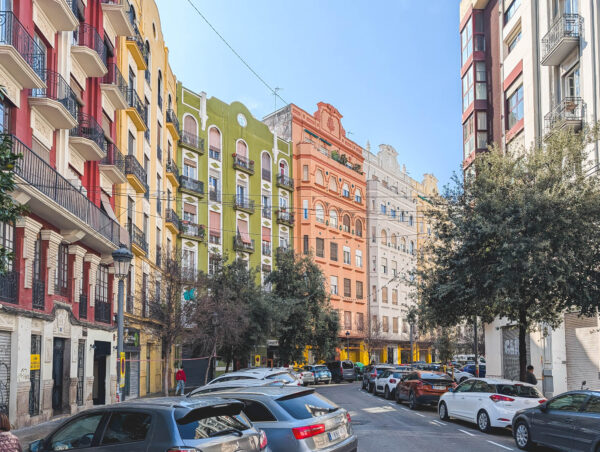
Typical architecture in Arrancapins. Photo by Alis Monte [CC BY-SA 4.0], via Connecting Valencia.
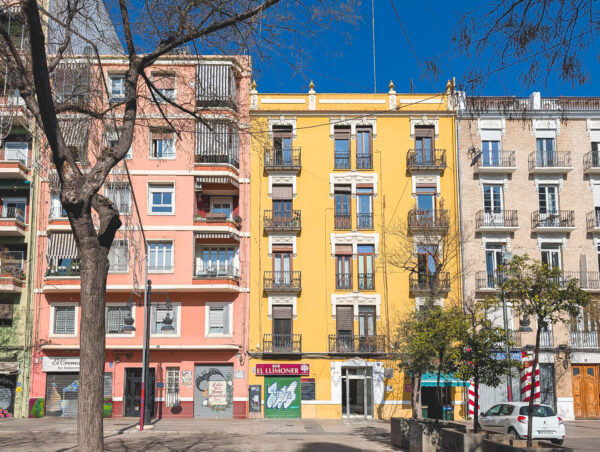
Typical architecture in Arrancapins. Photo by Alis Monte [CC BY-SA 4.0], via Connecting Valencia.
The interwar period gave Arrancapins its architectural signature. Under Spain’s 1925 affordable-housing law (Ley de Casas Baratas), the Finca Roja was built between 1929 and 1933 as worker housing, while the surrounding streets filled with apartment blocks. After the Spanish Civil War, the monumental Mercado de Abastos opened in 1948 as the city’s main wholesale market. As Valencia modernized through the late 20th century, the market closed and was reborn as a civic complex, and the barrio settled into its current identity: a calm, well-connected, intensely local quarter that preserves its early-20th-century character.
Timeline of Important Historical Events
- Pre-19th century: Land of orchards and pine groves outside the walls; site of the San Vicente suburb and a chapel linked to Saint Vincent Martyr.
- 1865: Valencia demolishes its medieval walls, opening the way for the Ensanche expansion that absorbs the area.
- Late 19th–early 20th c.: Arrancapins develops as a working-class neighborhood during Valencia’s industrial growth.
- 1929–1933: Construction of the Finca Roja under the 1925 affordable-housing law (architect Enrique Viedma Vidal).
- 1948: The Mercado de Abastos opens as Valencia’s main wholesale market (architect Javier Goerlich Lleó).
- 1991: Renovation begins to convert the former Mercado de Abastos into an educational, cultural, and sports center.
Name Origins
“Arrancapins” comes from Valencian and translates roughly as “pull up the pines,” a reference to the clearing of pine groves that once covered this land before the city expanded westward. The Spanish form is “Arrancapinos.” The name preserves the memory of the barrio’s agricultural past, when it lay outside the walls among orchards and woodland.
Notable Landmarks and Historical Sites in Arrancapins
Arrancapins is short on grand monuments but rich in 20th-century architecture and everyday civic landmarks. These are the sites that define the barrio’s character.
La Finca Roja
The barrio’s emblem and one of Valencia’s most striking residential buildings, the Finca Roja (“Red Estate”) fills an entire block bounded by Carrer de Jesús, Marvà, Maluquer, and Albacete. Built between 1929 and 1933 by architect Enrique Viedma Vidal under the 1925 affordable-housing law, it blends Dutch expressionism, Art Deco, and Valencian casticismo. Its unmistakable crimson-brick façade rises over a base of Godella stone, and the original complex contained around 378 apartments of roughly 100 m² / 1,075 sq ft arranged around 14 interior courtyards designed as shared social spaces for working-class families. It remains a private residential building, but the exterior is free to admire from the street.
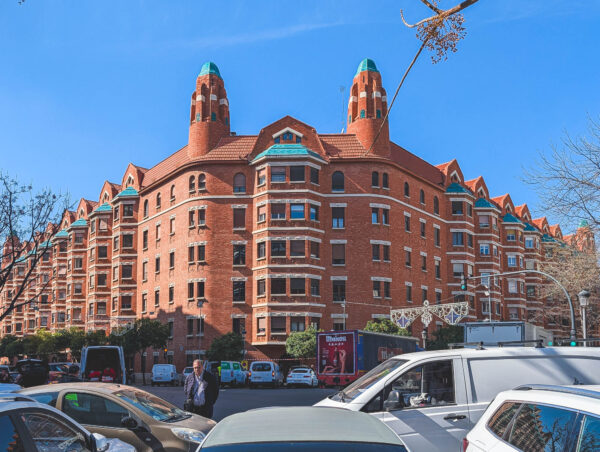
La Finca Roja (The Red House). Photo by Alis Monte [CC BY-SA 4.0], via Connecting Valencia.
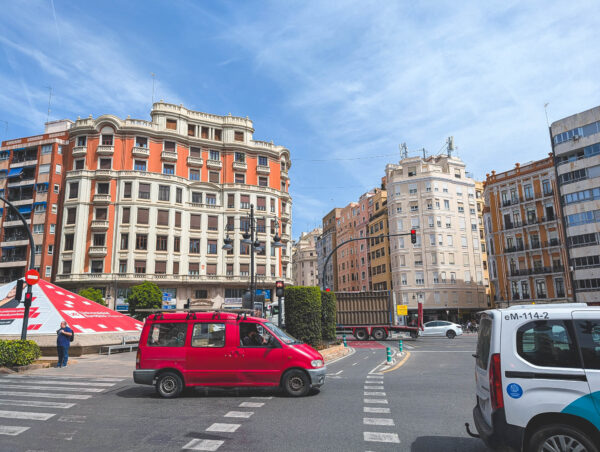
Plaza de Espana. Photo by Alis Monte [CC BY-SA 4.0], via Connecting Valencia.
Plaza de España
This busy square anchors the eastern edge of Arrancapins and functions as one of its main gateways to the rest of Valencia. Beyond its everyday traffic and cafés, Plaza de España is a key transport node: its metro station (lines L1 and L2) links the barrio quickly to the center, the airport, and outlying towns. From here it’s a 5–10 minute walk to the historic center.
Mercado de Abastos (Former Wholesale Market)
A monumental rationalist building designed by architect Javier Goerlich Lleó, the Mercado de Abastos opened in 1948 and spans about 23,800 m² / 256,000 sq ft between Carrer d’Alberic and Carrer del Bon Orde. Conceived as Valencia’s main post-war wholesale food market, it soon proved too central for heavy truck traffic and closed in the 1970s–80s. After renovation from 1991, it reopened as a civic complex that today houses a municipal sports center with a swimming pool, a public library, a secondary school, and a National Police station. Locals in the northern half of the barrio often refer to their whole area simply as “Abastos.”
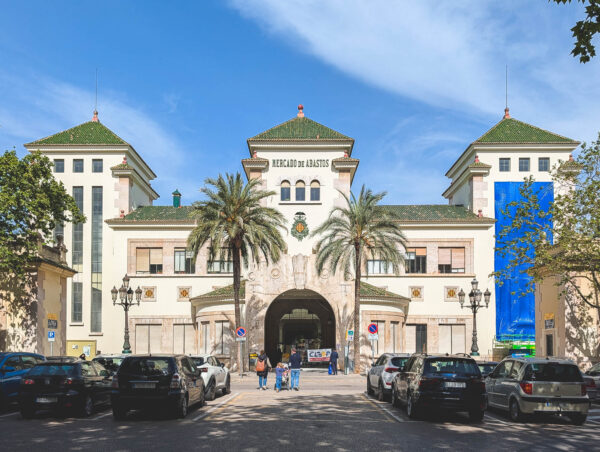
Abastos market (front). Photo by Alis Monte [CC BY-SA 4.0], via Connecting Valencia.
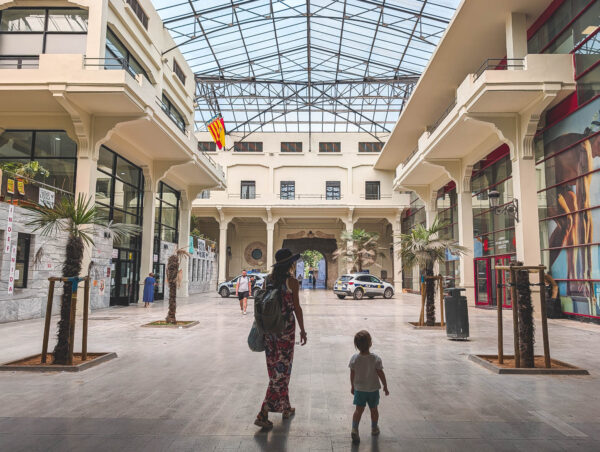
Abastos market (patio). Photo by Alis Monte [CC BY-SA 4.0], via Connecting Valencia.
Parque de la Cultura
A welcome pocket of green within the dense grid, the Parque de la Cultura covers about 9,000 m² / 97,000 sq ft and offers a bike lane, a skating rink, children’s play areas, and dedicated dog zones. It’s a practical neighborhood park rather than a destination, but it gives families and residents a local open-air space without heading to the Turia Gardens.
Things to Do in Arrancapins
Arrancapins rewards slow, local exploration rather than monument-hopping. Here’s how to experience the barrio the way residents do:
Admire the Finca Roja
Set aside time to walk the full block around the Finca Roja and take in its red-brick geometry from each side. The building photographs beautifully in late-afternoon light, when the brick warms and the Art Deco detailing stands out. If a courtyard gate happens to be open, you can glimpse the shared interior patios that defined its progressive social design—but respect that it’s a private home.
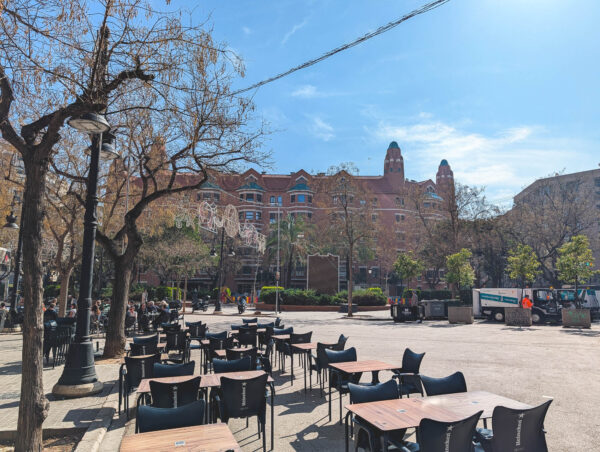
Plaza del pintor Sagrelles near La Finca Roja. Photo by Alis Monte [CC BY-SA 4.0], via Connecting Valencia.
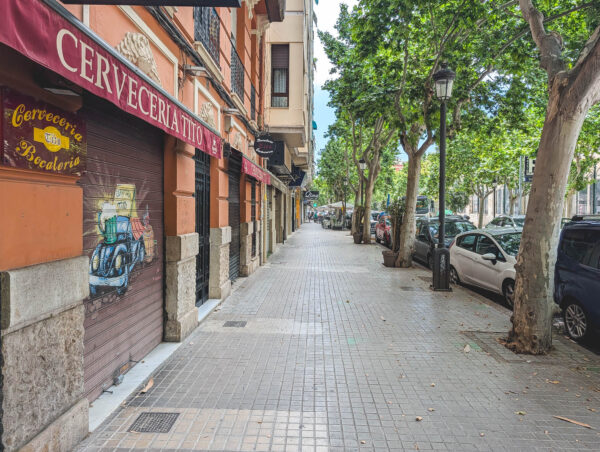
Arrancapins belongs to locals – you need to come at proper time to feel the real vibe of the district. Photo by Alis Monte [CC BY-SA 4.0], via Connecting Valencia.
Eat Like a Local in Abastos
The northern “Abastos” half of the barrio is one of Valencia’s best-value eating zones. Wander the streets around the old market for classic almuerzo (mid-morning) bars, traditional tapas counters, and bakeries serving fresh coca and pastries. This is everyday Valencian food culture without tourist mark-ups—follow the busy local spots at lunchtime.
Shop the Local Streets
Carrer d’Àngel Guimerà and the surrounding grid host a dense mix of neighborhood commerce: bakeries, greengrocers, hardware stores, pharmacies, and independent shops that serve residents rather than visitors. It’s a window into ordinary Valencian life and a practical base if you’re staying nearby and want to cook and live like a local.
Use It as a Base for the City
Arrancapins works brilliantly as a launchpad. From here you’re roughly a 15-minute walk to the Mercat Central and Ciutat Vella, about 20 minutes to Ruzafa’s nightlife and brunch scene, and under 10 minutes on foot to the Joaquín Sorolla AVE station for high-speed trains to Madrid. The barrio’s calm makes a pleasant counterpoint to busier districts.
Places to Eat and Drink in Arrancapins
Arrancapins, and especially its Abastos half, is a quietly excellent food neighborhood—honest tapas bars, traditional almuerzo counters, and good-value local restaurants rather than tourist showpieces.
Tapas and Seafood
The barrio’s standout is Rausell (Carrer d’Àngel Guimerà), a long-running bar famed across the city for top-quality seafood tapas, prawns, and a serious wine and vermouth selection—busy, classic, and worth the wait. Around the old Mercado de Abastos you’ll also find a cluster of traditional counters serving fresh fish, croquettes, and montaditos at honest prices.
Almuerzo and Coffee
Mornings here mean the Valencian almuerzo—a hearty mid-morning sandwich (bocadillo) with a small beer or coffee. Neighborhood bars along Carrer d’Àngel Guimerà and the streets around Abastos do generous bocadillos and breakfast plates for a few euros. For a slower coffee, the cafés around Plaza de España and the leafy stretches of Av. Fernando el Católico offer terraces for people-watching.
Lunch and Dinner
For midday value, look for the many local restaurants advertising a menú del día—typically three courses with bread and a drink at a fixed price. Traditional Valencian rice dishes (paella valenciana, arròs del senyoret, arròs negre) appear on most menus; for the city’s best-known paella institutions you’re a short walk or tram ride away. The barrio’s proximity to Ruzafa also puts a wide range of international and modern dining within 15–20 minutes on foot.
Accommodation in Arrancapins
Arrancapins isn’t a hotel hub, which is part of its appeal: you get residential calm and local prices while staying within walking distance of the center and the high-speed train station. Most stays here are short-term apartment rentals in early- to mid-20th-century buildings, many of them renovated.
For hotel comfort, the area around Plaza de España and the nearby Joaquín Sorolla railway station offers practical mid-range options with quick connections to the airport and the historic center. Travelers who want to be steps from the old city can also look at neighboring La Roqueta, by Estació del Nord.
For apartment stays, the streets around Carrer d’Àngel Guimerà and the Abastos area give you bakeries, produce shops, and cafés downstairs, plus easy metro access. Interior streets are noticeably quieter than the avenues and stations, so request an inner-facing room if you’re a light sleeper.
Getting to & around Arrancapins
Arrancapins is one of Valencia’s most transit-rich barrios, ringed by metro stations, bus lines, and a high-speed rail terminal, all within a compact, walkable grid.
By Metro
The barrio is exceptionally well served. Àngel Guimerà is one of Valencia’s largest interchanges, with lines L1, L2, L3, L5, and L9, linking directly to the airport (L3/L5) and across the metropolitan area. Plaça d’Espanya (lines L1, L2) anchors the eastern edge. A single metro ticket costs around €1.50; the 10-trip Bonometro is a better value for multiple journeys.
By Train (AVE / Renfe)
The Joaquín Sorolla high-speed station sits less than a 10-minute walk south of the barrio, with AVE services to Madrid (under two hours) and other Spanish cities. The adjacent Estació del Nord, by neighboring La Roqueta, handles regional and Cercanías trains. This makes Arrancapins one of the most convenient barrios for arriving or departing Valencia by rail.
By Bus
Multiple EMT city bus lines cross the barrio along its main avenues, with major stops at Àngel Guimerà and Plaza de España. The airport Metrobús 150 also stops at Àngel Guimerà on its way into the center. Because EMT routes are periodically adjusted, check live routes and times on the official EMT Valencia app or website. Single tickets cost around €1.50.
By Bicycle
Valencia is among Spain’s most bike-friendly cities, and Arrancapins has several Valenbisi bike-share stations plus marked cycle lanes along its avenues. The car-free Turia Gardens run right along the northern edge, offering a flat, scenic route across the city. Weekly Valenbisi passes are inexpensive; the terrain is flat throughout.
By Car
Sitting between the Pérez Galdós and Fernando el Católico avenues, Arrancapins is easy to reach and exit by car, but on-street parking is scarce and largely regulated (ORA zones). Given the dense metro, bus, and rail links, driving isn’t recommended for getting around—use public transport or a perimeter parking garage and explore on foot.
Personal Favourites
Arrancapins is the kind of barrio you don’t notice on a first visit to Valencia, and then can’t stop returning to once you know it. It has no cathedral, no famous towers, nothing to tick off a list—and that’s exactly the point. What it has instead is life on the street at every hour, a density of bakeries and corner bars that means you’re never more than a block from a decent coffee, and a sense that you’re seeing how the city actually lives rather than how it performs for visitors.
The Finca Roja is my anchor here. I find myself walking the long way around it just to watch the red brick change with the light, thinking about how a building designed as cheap worker housing nearly a century ago ended up as the most beautiful thing in the barrio. It says a lot about Arrancapins: unpretentious, generous, quietly proud of itself without needing to announce it.
For food, I send everyone to the Abastos streets. A morning almuerzo at a packed local bar, a long seafood lunch at Rausell, an evening vermouth before drifting toward Ruzafa—it adds up to a perfect, unflashy Valencian day. The barrio sits so conveniently between the old city, the train station, and the Turia Gardens that I keep recommending it as a base, especially to people who’ve already “done” the center and want to feel like residents instead. It won’t dazzle you in an afternoon, but give it a few days and Arrancapins becomes the version of Valencia you actually miss.
Frequently Asked Questions
What is Arrancapins known for?
Arrancapins is known for its authentic, lived-in residential character, the landmark Finca Roja building, the former Mercado de Abastos (now a civic and sports complex), excellent-value tapas, and its central location with strong transport links in Valencia's Extramurs district.
Where is Arrancapins located in Valencia?
Arrancapins is a barrio in Valencia's 3rd district - Extramurs, west of the old city between the avenues Pérez Galdós and Fernando el Católico. It borders La Petxina to the north, La Roqueta and Ruzafa to the east, La Raiosa to the south, and Patraix to the west.
How do I get to Arrancapins?
Take the metro to Àngel Guimerà (lines L1, L2, L3, L5, L9) or Plaça d'Espanya (L1, L2). The Joaquín Sorolla AVE station is under a 10-minute walk away, and multiple EMT bus lines, including airport line 150, stop at Àngel Guimerà. The barrio is also about a 15-minute walk from the Mercat Central.
Why is Arrancapins also called Abastos?
Residents of the northern half of the barrio often call their area "Abastos" after the Mercado de Abastos, the large former wholesale market that opened in 1948 and is now a cultural and sports complex. The nickname has become shorthand for that part of Arrancapins.
What does the name Arrancapins mean?
Arrancapins comes from Valencian and translates roughly as "pull up the pines," referring to the clearing of pine groves that once covered the area before Valencia expanded westward. The Spanish form of the name is Arrancapinos.
Is Arrancapins safe?
Yes, Arrancapins is considered a safe, family-oriented residential barrio. It has a high population density and plenty of street life at most hours, which keeps it active and well-observed. As with any central urban neighborhood, standard precautions apply around busy transit hubs like Àngel Guimerà.
What is the best time of year to visit Arrancapins?
Arrancapins is a year-round residential neighborhood with no specific tourist season. Spring (March–May) and autumn (September–November) offer the most comfortable temperatures for walking. March brings Las Fallas, when the whole city celebrates, and the barrio's streets join the citywide atmosphere with bonfires and fireworks.
Are there green spaces in Arrancapins?
Yes. The Turia Gardens run along the barrio's northern edge, offering 9 km / 5.6 mi of car-free park for walking, cycling, and play. Within the barrio itself, the Parque de la Cultura provides a smaller local park with a bike lane, skating rink, and children's play areas.